|
|
|
…12,725 founders and ecommerce operators are reading this newsletter today…
|
The Price - CAC Spiral
⏱ 5-minute read
CAC edges up, not dramatically, just enough to matter. The first response is almost never to raise prices. It's to discount. Promos get deeper, bundles get more aggressive, offers get stacked. Volume holds, but margin quietly erodes.
So the team raises prices to recover margin. That adds friction to every conversion. Customers need more convincing, creative gets heavier, retargeting expands. CAC edges up again.
Each decision made sense in the meeting where it was made. Taken together over twelve months, they describe a business working harder and harder for the same result.
That's the spiral, and most teams don't see it until they look back at a full year of data and realize the entire model has become more expensive and more fragile simultaneously.
Without stronger LTV or a staple repeat product underneath the model, the loop keeps tightening.
Price-CAC Spiral
The Price–CAC Spiral.
Rising CAC pushes prices up to protect margin → conversion gets harder → CAC rises again. Without stronger LTV and a staple ‘milk’ product, the spiral tightens until growth stalls.
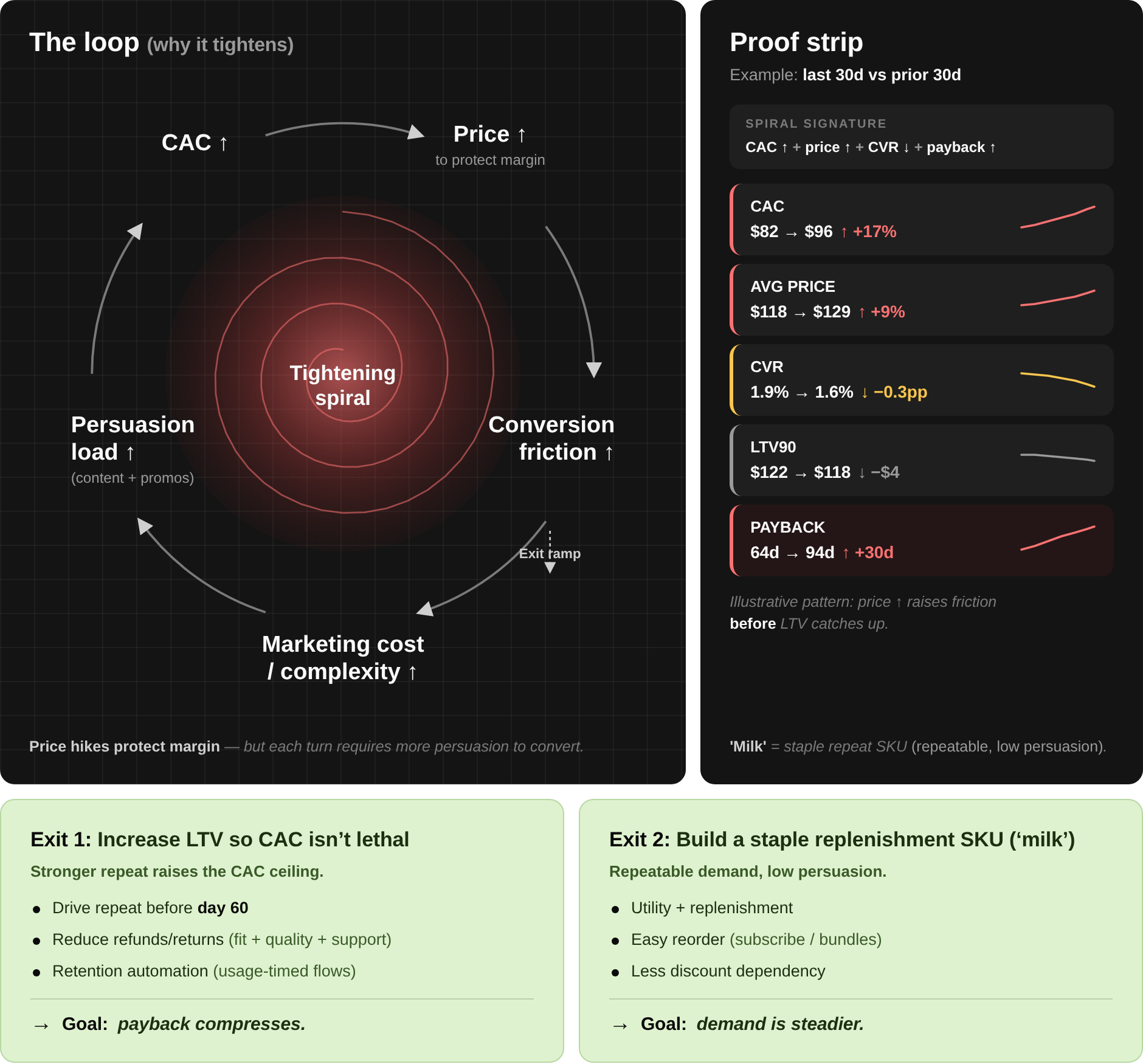
Fix the engine: LTV + product mix. Not louder marketing.
Four Principles Worth Internalizing
Discounts feel like a CAC fix. They're often a margin problem in disguise. Deeper promos defend volume by making conversion cheaper. But they compress contribution margin, attract discount-dependent cohorts, and create the conditions that make a price increases necessary. The discount isn't solving the CAC problem, it's deferring it while making it worse.
Price hikes change persuasion load, not just margin. Every time you raise price, you're asking the market for a new level of belief. More proof, more creative variation, more objection handling. A price increase can protect CM1 on the order and still weaken the business if it raises the cost of getting someone to say yes.
CAC problems are often retention problems in disguise. If customers came back fast and repaid CAC quickly, rising acquisition costs would be easier to absorb. The real danger isn't expensive traffic, it's expensive traffic landing in a business with weak repeat behavior. LTV is what turns CAC from lethal into manageable.
Most brands need a “milk” product. The name comes from grocery logic: milk is what every supermarket is built around. Not the most exciting SKU, but the one that brings customers back on a reliable cycle without persuasion. In eCommerce terms: a repeatable, low-friction staple, daily moisturizer, coffee, refills, supplements. Without one, growth becomes narrative-heavy and fragile. If your model doesn't support repurchasable SKUs, you need clear journey starters: products that naturally lead to follow-up purchases.
|
✓
|
|
The Operator Playbook
|
| What to actually change |
| Five operator moves to break the Price–CAC spiral before it stalls growth. |
|
|
|
|
Build a weekly Price–CAC Spiral dashboard.
CAC, discount rate, average selling price, conversion rate, LTV90, payback, and return rate. One view, by channel and SKU. Discount rate belongs here because discounting is almost always the first move in the spiral, before prices ever change. You want to see it forming early, before the team explains it away as creative fatigue or seasonality.
|
|
|
Classify your catalog into persuasion-heavy vs staple-repeat.
Measure 60–90 day repeat rate, CM1, and return rate by SKU. This tells you which products can carry scale and which only perform when marketing pressure is high.
|
|
|
Set price guardrails based on payback, not margin alone.
Before raising prices, define the rule: if conversion drops and payback crosses your threshold, the hike failed. Price should be judged by what it does to the full customer economics map.
|
|
|
Make repeat effortless on your staple product.
Subscription, refill reminders, one-click reorder, post-purchase flows timed to usage — compress payback by making repeat happen sooner.
|
|
|
Cap spend on narrative-heavy SKUs until they earn it.
Don't let the ad account crown a hero that customer economics can't support.
|
|
|
BOOK YOUR AUDIT →
|
|
The Real Takeaway
Louder marketing doesn't break the spiral. Stronger customer economics do. Faster repeat, better LTV, and at least one staple repeat engine in the catalog. Fix the engine and CAC becomes survivable.
Reply SPIRAL and I'll tell you where I'd look first in your data.
|
Reader questions
|
| Ask me anything. |
| Smart questions from operators in my inbox. Honest answers from the founder of RetentionX. |
|
|
How do you spot the spiral forming? |
|
|
|
|
| Look for a consistent pattern across two comparable periods, last 30 days versus the prior 30: CAC up, discount rate up, average selling price up, CVR down, payback longer. That sequence means you're buying margin with price and losing it back in conversion friction. If LTV isn't climbing fast enough to compensate, the business is getting less cash-safe even if revenue holds. |
|
|
|
How do you know it's the spiral and not just a bad month? |
|
|
|
|
| A bad month shows CAC up and CVR down. The spiral shows price rising as a deliberate response, and payback stretching because LTV doesn't catch up. If you see that sequence repeating across periods, it's structural, not noise. At that point you stop optimizing campaigns and start fixing product mix and retention math. |
|
|
|
What exactly is a milk product? |
|
|
|
|
| A high-repeat, low-persuasion SKU that customers repurchase on rhythm without needing to be re-sold on its value. It funds the business by stabilizing demand, raising your CAC ceiling, and reducing the pressure to keep hiking prices to cover marketing costs. Most stalled brands don't lack traffic — they lack this kind of repeatable base. |
|
|
|
If we're already in the spiral, what do we fix first? |
|
|
|
|
| Adjust your entry product mix so you're not acquiring customers who can't move up your price architecture. Pricing changes alone rarely solve it — they usually intensify conversion friction unless the customer journey improves first. Focus on increasing LTV and reducing refund and return drag — that directly compresses payback. Fix cohort economics, then scale. |
|
|
|
How do you get teams to stop defaulting to more persuasion? |
|
|
|
|
| Change the scoreboard. Move from campaign wins to payback and CM1 by cohort. When teams can see that more promos can raise revenue while payback gets worse, the behavior changes quickly. Make it explicit: every additional persuasion layer is a cost that needs to earn its keep in cohort profit, not just clicks. |
|
|




 Listen on Spotify