
| …12,661 founders and ecommerce operators are reading this newsletter today… |



The Acquisition Treadmill Ratio
Most brands know how much revenue they generated this month. Far fewer know how much of it depended on acquiring brand-new customers all over again. That distinction matters, because a business can grow revenue while becoming more cash-hungry and more dependent on paid acquisition every month.
For most brands, the share of revenue that comes from new customers in a given month tends to be most of it, often exceeding 60%. There is a class of operators who view this as health: new customers arriving while CAC holds steady. But when two-thirds of a month's revenue is acquired fresh, the business effectively restarts every thirty days. A CPM spike or a soft week on Meta quickly reveals the shaky foundation of rented growth. That isn't a flywheel. It's an acquisition treadmill.
Same Topline. Different Business.
How much of this month’s revenue had to be bought again from scratch? That's the Acquisition Treadmill Ratio.
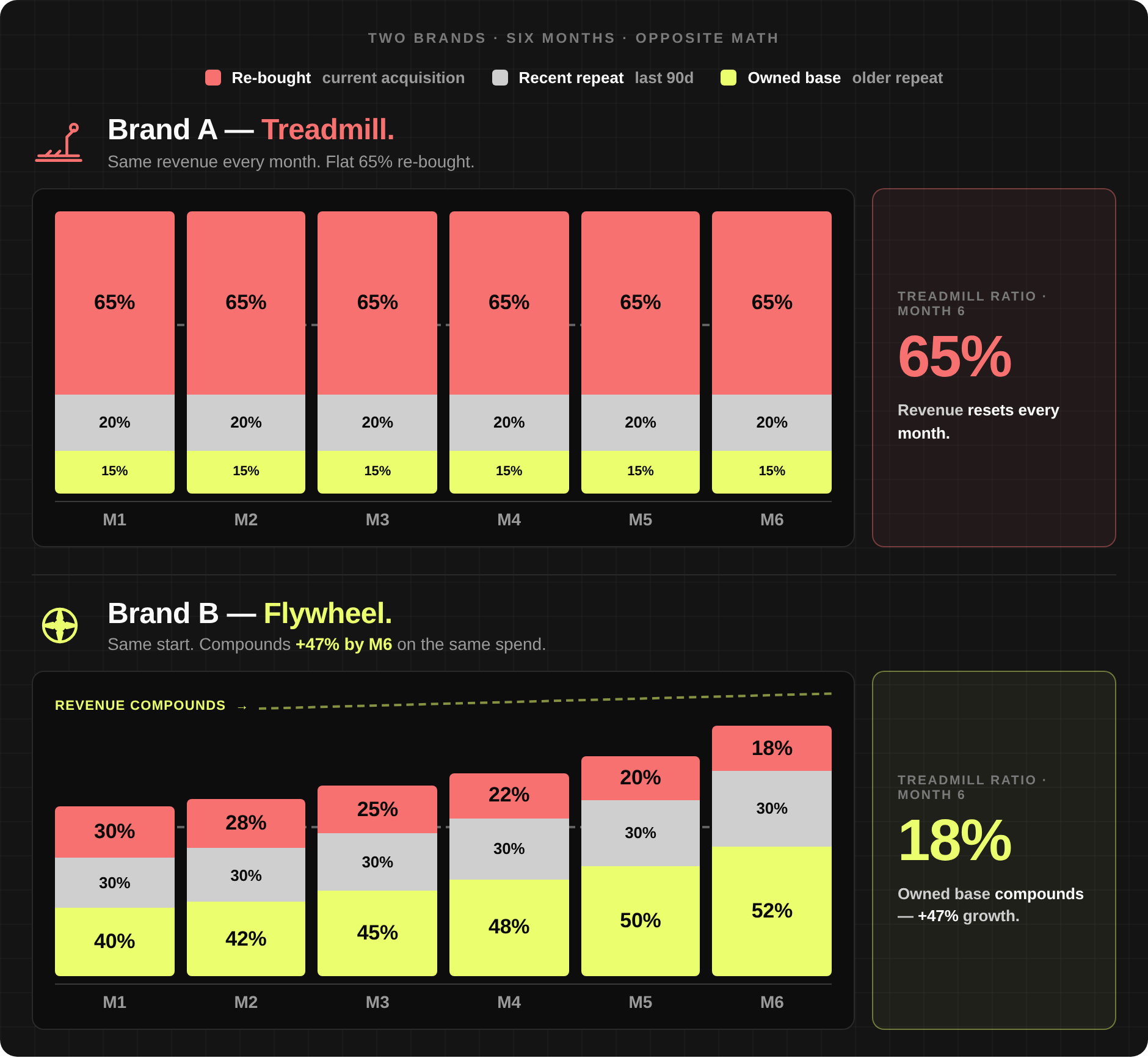
to "How do we build a base?"
The same topline number can sit on a completely different foundation. The businesses that understand this optimize for retention and end up with a revenue composition where current-month new customers sit somewhere around 20%, while repeat buyers and older cohorts carry the rest.
When older customers keep producing, repeat becomes the floor, and businesses build on a base of owned revenue instead of buying back every dollar of revenue each month. The topline on the P&L might be identical, for now, but the business with a repeat flywheel will quickly pull ahead.
The ATR Metric
Current-month customer acquisition divided by total revenue. That's the whole KPI. When that ratio runs too high, the business resets every month. You can still hit revenue targets, grow new-customer count, report healthy CAC, and look efficient in-platform, and still be structurally exposed, because too much of the month depends on buying fresh demand again.
A ratio over 50% means the customer file is eroding at the same rate at which new customers are acquired. First orders aren't turning into second orders fast enough, older cohorts aren't repurchasing, and acquisition is quietly compensating for a base that leaks. The ratio doesn't only measure how much you lean on acquisition. It tells you whether the customers you already paid for are still driving revenue.
Four Principles for Applying The Acquisition Treadmill Ratio
New-customer revenue isn't automatically good news. A high share of revenue from new customers can mean you're scaling, or that your existing base is too weak to support the business. Without the repeat breakdown, you can't tell which story you're reading.
Repeat revenue is the floor. The more older cohorts contribute each month, the less the business leans on acquisition, which gives you room to absorb CAC volatility, test new channels, and protect margin. Repeat doesn't only raise LTV; it lowers operational stress.
A flat ratio is a warning. Sitting at 60–70% current-month acquisition month after month means the base isn't compounding. You may be growing, but you're growing in a way that has to be refilled from scratch every month. That's rarely sustainable.
The goal isn't less acquisition, it's acquisition that matters less to survival. You still need new customers. They should sit on top of a stronger base, not replace it every month. The healthiest brands acquire to expand the base, not to refill what leaked out.
A business isn't built when acquisition spikes. It's built when repeat customers become the base. Topline alone won't tell you which one you're running, the ratio will. When it trends down, LTV becomes more durable, cash flow gets safer, and growth stops depending on whatever next month's CPM’s looks like.
-Alex
Ask me anything.
Smart questions from operators in my inbox — my honest answers on the treadmill ratio.
It depends heavily on category and maturity, but for many scaled brands I'd start to worry once current-month acquisition is consistently above 50% of monthly revenue in a normal month. For younger brands that can be fine for a while; for mature ones it usually means repeat revenue isn't becoming a strong enough base. The trend matters more than any single month.
Subscription renewals belong in base revenue, because they reduce monthly fragility, but I'd split them out on their own line. Otherwise a brand can look stable while churn worsens. I'd show three lines: revenue from new customers, revenue from repeat non-subscription buyers, and revenue from subscription or auto-replenishment. The healthy version isn't just "less dependence on new revenue" it's durable base revenue with strong survival and healthy CM1..
Judge seasonal spikes against the right baseline. Compare the ratio to the same period last year, then watch the subsequent 60–120 days. If November runs a high treadmill ratio but those customers move into recent-repeat and older-repeat revenue later, that's healthy acquisition. If they disappear, it was seasonal volume, not a stronger customer base..
I'd start with the first-to-second-order system, because it's usually the fastest way to change the mix. Then I'd look upstream at acquisition quality, specifically which channels, SKUs, and offers are producing customers who never come back. Product mix matters too; some products simply don't create a natural second purchase. The goal is to make repeat a system, not a hope..
Yes — if people treat it as something to optimize in isolation. The point isn't "less acquisition is always better." It's that acquisition should build a base that keeps producing. I'd pair the treadmill ratio with new-customer volume, payback, and cohort CM1 so teams don't starve acquisition. Healthy brands still acquire, they just don't depend on re-acquiring every month.h.

 Listen on Spotify