
| …12,781 founders and ecommerce operators are reading this newsletter today… |


A customer's next purchase window isn't universal. Get the timing wrong and you either arrive too early and create annoyance, or too late and miss the moment repeat behavior could have been built.
Most retention programs run on a calendar the business controls, not the rhythm the customer buys on. That mismatch shapes repeat purchase rate, LTV, discount dependency, and whether your retention feels natural or intrusive.
Stop using one cadence for everyone.
1st-time vs 4th-time buyers have different gaps — the same email at the wrong moment churns one and annoys the other.
The Problem with “Send After 30 ays”
Consider this post-purchase flow for a single-SKU supplement brand: Everyone gets a day 7 education email, a day 21 product recommendation, a day 30 "come back" offer, and a day 45 winback. Clean, simple, easy to manage.
But the customer base doesn't behave cleanly.
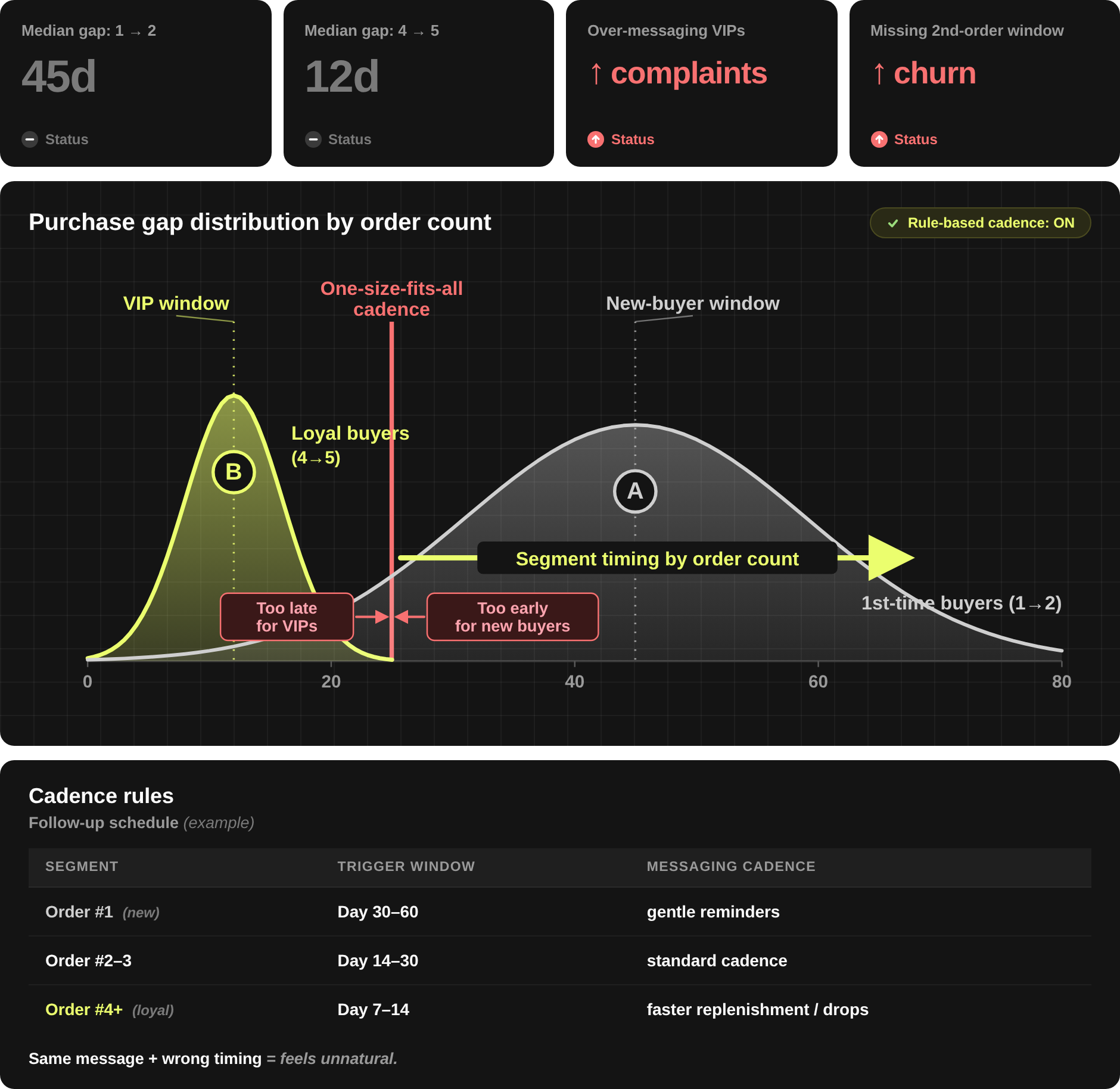
A first-time buyer who just discovered the brand might wait 45–60 days before order #2. They're still building trust, deciding whether they are seeing results. They haven’t built true routine. A fourth-time buyer might come back every 10–14 days because the product has become part of their routine.
Now both receive the same day 30 message. For the first-time buyer, day 30 is too early. For the loyal buyer, day 30 is too late, you missed their natural reorder window, and by then they may have bought elsewhere or dropped out of rhythm.
Messaging cadence should follow customer behavior, not a campaign calendar.
What To Do Differently
Order count changes buying behavior. The purchase gap usually shortens as loyalty builds: new customers often take longer to place order #2 than loyal ones take to place order #5. Your cadence should compress as the buying cycle does.
Product matters as much as order count. Someone who bought a cleanser doesn't have the same reorder window as someone who bought coffee or supplements. Some products replenish, some are seasonal, some are one-off. The last product purchased should shape timing as much as lifecycle stage.
Bad timing creates false conclusions. When a flow underperforms, most teams blame the creative or the offer. Often the message is fine, it's just arriving at the wrong moment. Too early creates unsubscribes; too late makes customers look unresponsive when you simply missed the window.
The best cadence feels invisible. Strong retention doesn't feel like pressure. It feels like the brand showing up right when the customer was about to need something. That's the difference between "why are they emailing me again" and "good timing, I actually need this."
The Real Takeaway
Most retention programs are overbuilt on message volume and underbuilt on timing. If you want stronger LTV, match your follow-up rhythm to the customer's actual buying rhythm: order count, product purchased, replenishment time, expected next window. That's how retention stops feeling like pressure and starts becoming habit.
-Alex
Ask me anything.
Smart questions from operators in my inbox — my honest answers on messaging cadence.
Start simple: order count + product family. That usually gets you 80% of the lift without creating an operational mess. Once you see clear differences, you can go deeper into SKU‑level timing for high‑volume replenishable products. The goal isn’t infinite personalization — it’s avoiding obviously wrong timing.
Both matter. Time‑to‑second‑order tells you when the customer is naturally ready; the second product tells you whether the journey is healthy. A fast second order into a low‑margin or heavily discounted product isn’t the same as a fast second order into a strong repeat path. The best view is: first product → timing window → next product → CM1 over 90 / 180 days.
I usually anchor on the product that best predicts the next behavior, not necessarily the most expensive item in the basket. If there’s a replenishable product in the first order, that often becomes the timing anchor. If the basket is more of a curated set, I’d use product family or use‑case as the anchor instead of a single SKU. The mistake is treating a multi‑item first order like a generic “new customer” state.
Isolate timing first. Keep the content and offer mostly the same, then test different send windows against expected next‑purchase timing. Measure repeat rate, days to next order, unsubscribe / complaint rate, and CM1 per recipient — not just revenue. Once you find the right window, then improve the message.
Yes. Loyal customers often need fewer messages, not more. The cadence should be faster in the sense of being closer to their true buying window, but the volume can be lower because trust already exists. For them, the best experience is usually relevance, convenience, and low friction — not another education sequence.

 Listen on Spotify