
| …12,854 founders and ecommerce operators are reading this newsletter today… |


A full-price customer has already told you something useful: price isn't the barrier. They bought without an incentive, which means their buying rhythm works on its own. Send them a predictable coupon and you do more than give away margin. You teach them to wait for the next one.
Once a customer knows your sales are coming, the next purchase stops happening when they run low on the product. It happens when the discount lands. So you give up margin on an order that would have been full price, and over time you get fewer orders too, because a customer trained to wait buys less often than one who simply buys when they're ready.
The Hesitation Window
Couponing full-price buyers creates an incentive to delay their next purchase.
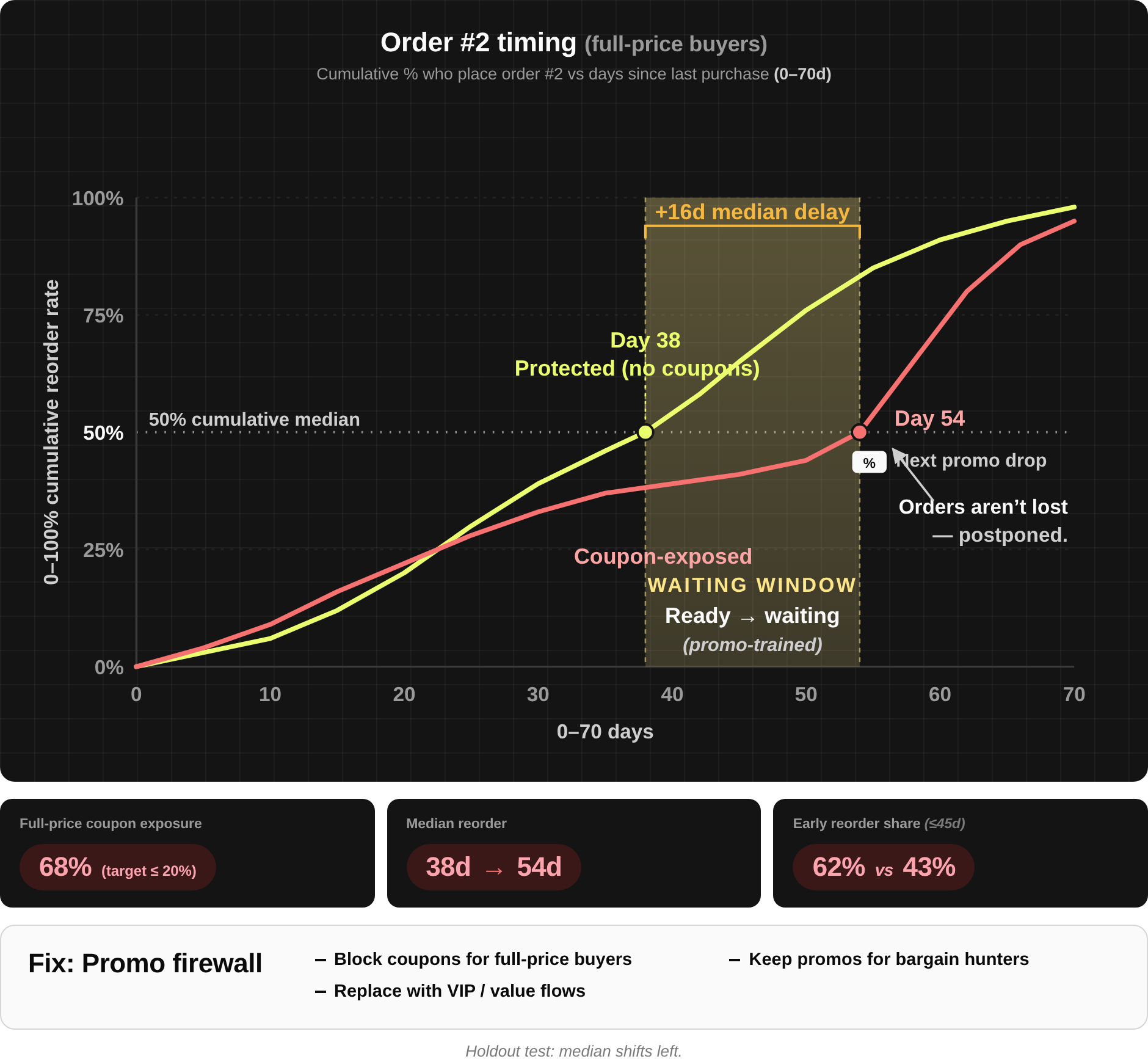
How a Good Customer Learns to Wait
A sitewide offer here. A winback coupon there. A "last chance" email that isn't really the last chance, because another one turns up 30 days later, with offers that get a little better the longer they hold out.
Your best buyers will learn quickly: Why buy today at full price when the brand has all but promised a discount is on the way? So they will wait. Not because they've cooled on the product, but because you've created an incentive structure in delaying the next purchase.
Multiply that across your best customers and two things happen at once. The orders that do come are discounted, so each one carries less margin. And some of the orders don't come at all, because a customer waiting for the perfect promo is a customer drifting out of the rhythm that made them valuable in the first place.
You gave up margin and delayed the next purchase.
The Hesitation Window
You can see this without guessing. Hold a group of your full-price customers out of the next promotion, let a comparable group receive it, and watch both over the following months.
The exposed group is the tell. If they buy less at full price, order less often, or start timing their purchases around your sales, you've found your hesitation window: ready customers holding off, waiting for a discount you trained them to expect.
It hides so well because the promotion still looks like a win. Orders cluster around the sale. Promo-attributed revenue climbs. What it never shows you is the full-price order that would have happened anyway, or the customer who's now waiting instead of buying.
When your best customers buy less often and more on discount, repeat revenue thins out, and new-customer spend has to cover the gap. That is what keeps the Acquisition Treadmill Ratio high.
The Takeaway
Your best customers don't need convincing that the product is worth the money. They settled that when they paid full price. What they need is a reason to come back when they're ready, and no reason to believe that holding out will be rewarded.
Protect the customers who buy on their own, keep your pricing credible, and save discounts for the people whose behavior actually earns them. Every time you put a coupon in front of someone who would have paid full price, you teach a habit you'll pay for on every order after.
-Alex
Ask Me Anything
Smart questions from operators in my inbox, and my honest answers on the hesitation window.
A holdout, and there’s no good substitute. Compare cumulative CM1 and days to next order at 60 and 90 days, not during the campaign. If the exposed group converts on the promo but lands at similar total CM1 by day 90, the promotion rearranged the calendar. It’s cheap to run and most teams still don’t, because the campaign report already says what they want to hear.
Reduce the blast radius: cap frequency, narrow paid amplification, pull protected segments out of promo retargeting. But I’d push back on “unavoidable.” If sitewide runs often enough that segmentation can’t work around it, the promo calendar has become the strategy, and it’s usually covering for a second-purchase system that isn’t working.
Look for a pattern, not an order. Timing clusters around your promo windows, full-price repeat rate weakens while engagement holds steady, and the median gap stretches. Every one of those reads as promo success in the dashboard, which is why timing metrics have to sit next to revenue ones.

 Listen on Spotify