|
|
|
…{{active_subscriber_count}} founders and ecommerce operators are reading this newsletter today…
|
Who Are Your VIP’s, Actually?
Most brands make customer segmentation too complicated, or worse, too arbitrary. someone says "let's call $500-plus a VIP," someone else says "three orders means loyal.” If everyone agrees, these thresholds go straight into the CRM.
In actuality, these arbitrary thresholds describe almost no one.
Every customer file is unique. Maybe $500 isn't VIP for this brand, it's just the top third. Maybe most good customers buy five or six times, so "three orders" is barely above average. Maybe a two-order customer with high AOV and clean margin is worth more than a frequent one who only ever buys on discount.
If you misread customer quality, you misallocate retention efforts, paid audiences, and service levels. That is where RFM comes in.
Customer Quality · RFM Map
Who are your VIPs, actually?
RFMRecency · Frequency · Monetary value
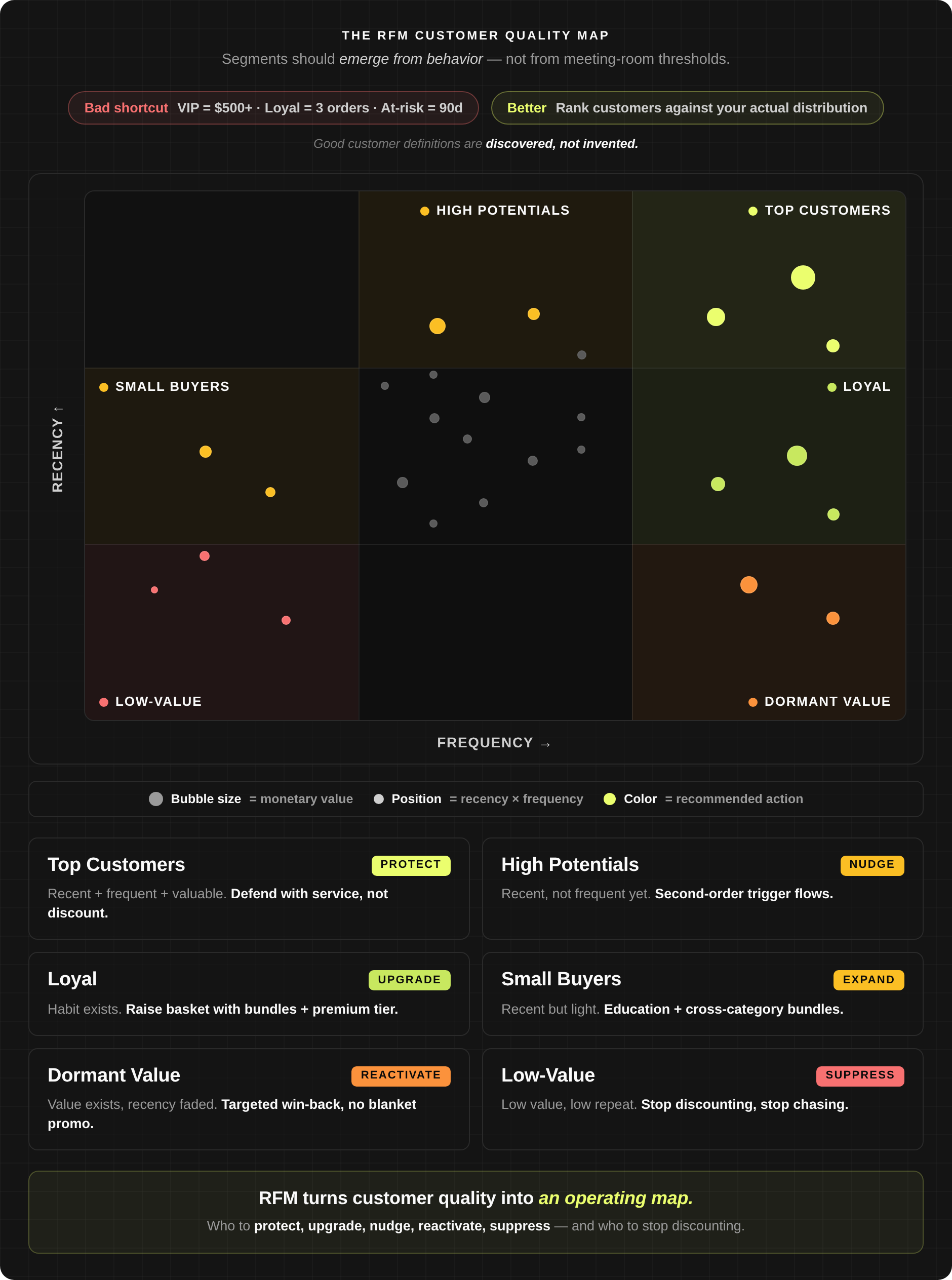
RFM 101
RFM ranks every customer on three behaviors:
Recency: how recently they bought
Frequency: how often they buy
Monetary value: how much they've generated
That's the whole model. Simple and powerful because it stops asking "what do we think a good customer is?" and starts asking "who is good relative to everyone else in our file?" The segments aren't invented; they're ranked against your own reality instead of category benchmarks taken from a deck.
Each axis catches something the others miss:
Recency keeps you honest. A customer who spent heavily two years ago isn't the same as one who bought last week. Recency tells you whether the relationship is still alive.
Frequency shows habit. A repeat buyer is proving the brand has entered their routine, a different asset than a single large order, however impressive that order looked on the day.
Monetary value adds economic weight. Not all frequent customers are equally valuable. Some customers buy often but small; others rarely but with real margin. This separates activity from actual impact.
Read together, the three turn a flat customer list into a behavioral map without requiring a six-month data project. The point is not to label customers. The point is to decide what to do with them: who to protect, who to upgrade, who to reactivate, who to exclude, and who to stop discounting.
|
✓
|
|
The Operator Playbook
|
| What to actually change |
| Five operator moves to turn RFM from a CRM tag into a cross-functional operating map. |
|
|
| Start with Distribution, Not Fixed Thresholds Don’t decide what counts as a “VIP” or a “loyal” customer in a meeting. Use the customer file to understand how the base is shaped. Each customer judged against the full file. |
| Go Deep on VIPs Your top group sets the standard for the whole file, so it’s the one to understand in detail. Understand how recently they buy, how often, what products they enter on, and which channel brings them in. That profile tells you what a genuinely high-value customer looks like and where to go find more of them. |
| Layer on CM1 RFM ranks behavior. Bring contribution margin, returns, and discount dependency onto the map and the view sharpens from who spends the most to who generates profit. |
| Score on the Right Clock Recency changes fast, and a customer can slip from high-potential to at-risk quickly. Refresh your action segments frequently enough that you catch the shift while there’s still something you can do about it. |
| Build Operating Actions A segment with no decision attached is just a label. Give each one a single job, protect the top, upgrade the loyal, nudge the high-potential, reactivate the dormant, suppress the worst, then run those jobs everywhere, not only in email. That’s the point: a map the business actually runs on. |
|
|
The Takeaway
Before you build anything more complex, make sure you understand the basic shape of your customer base. Arbitrary thresholds don't just misjudge one campaign, they quietly misallocate retention effort, promo margin, paid audiences, and service levels all at once.
RFM replaces the guess with a map drawn from how your customers actually behave. It's usually the best place to start.
Reply RFM and I'll tell you what your top and bottom segments would likely look like in your data first.
- Alex
|
Reader questions
|
| Ask me anything. |
| Smart questions from operators in my inbox — my honest answers. |
|
|
How often should RFM refresh? |
|
|
|
|
Alex says · Founder RetentionX |
|
| For most brands, monthly is enough for strategic planning — but the action segments should update much more frequently, ideally daily or weekly. Recency changes fast, especially for lapsing, in-market, and second-order opportunity segments. You don’t want to wait a month to catch someone moving from “high potential” to “at risk.” The rule: strategy monthly, activation continuously. |
|
|
|
Do you recommend fixed thresholds, or ranking customers against the actual distribution? |
|
|
|
|
Alex says · Founder RetentionX |
|
| Strongly prefer ranking against the brand’s actual distribution. Fixed thresholds like “VIP = $500+” sound clean, but they often have nothing to do with the shape of the customer file. In one brand, $500 might be normal; in another, it’s elite. RFM works best when the segments emerge from behavior — not from a meeting-room guess. |
|
|
|
How do you layer margin into RFM? |
|
|
|
|
Alex says · Founder RetentionX |
|
| RFM is the starting map, not the full truth. Layer in CM1, returns, discount dependency, and support friction to separate high-revenue customers from genuinely high-quality customers. A customer who spends a lot but returns half the order or only buys with 30% off should not be treated like a clean VIP. The best version is RFM + profit quality. |
|
|
|
What’s the first campaign you’d change after building an RFM map? |
|
|
|
|
Alex says · Founder RetentionX |
|
| Usually promo suppression and second-order nudges. Protect your best customers from unnecessary discounts, and move high-potential first-time buyers toward order two with relevant product journeys. Those two moves improve margin and retention quickly without a big rebuild. After that, look at paid audiences: exclude low-value segments and seed lookalikes from genuinely high-quality customers. |
|
|
|
How do you prevent teams from overcomplicating this? |
|
|
|
|
Alex says · Founder RetentionX |
|
| Tie every segment to one job. If a segment doesn’t have a clear action — protect, upgrade, nudge, reactivate, suppress — it probably doesn’t need to exist. The goal isn’t a beautiful segmentation model. It’s better decisions across CRM, paid, service, and merchandising. Six segments the team uses every week beats thirty segments nobody trusts. |
|
|



 Listen on Spotify