Stickiness Matrix · Tactical Slide
Two Product Superpowers
Measure brand vs product stickiness — treat them like different muscles.
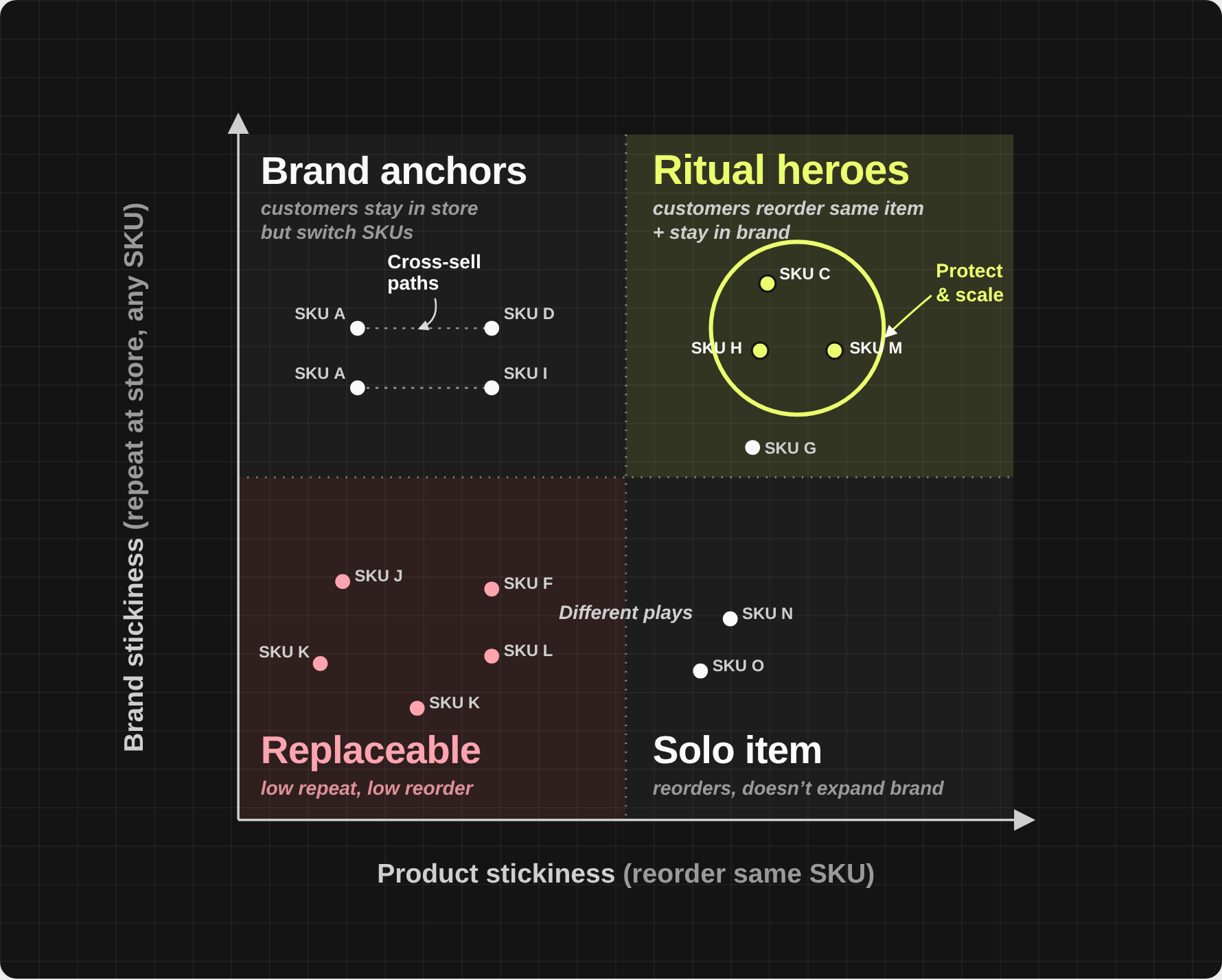
Find your Ritual heroes. Then double down.
Most teams talk about “stickiness” as if it’s one thing. It isn’t. If you confuse a product that keeps people inside your brand with a product they reorder again and again, you will misallocate paid spend, merchandising, and lifecycle effort — and that shows up in weaker LTV, slower payback, and more discount-dependent growth.
A simple example
Imagine a skincare brand with two standout products.
The first is a cleanser. Customers don’t necessarily reorder the exact same cleanser at unusually high rates, but they do come back to the brand. They buy the serum next. Then the moisturizer. Then a mask. The cleanser is creating store loyalty, not necessarily SKU loyalty.
The second is a daily SPF. Customers reorder it like clockwork every 45–60 days. But many of them don’t explore beyond it. They stay loyal to the item, not to the broader assortment. The SPF is a ritual product.
Now imagine the team treats both products the same way:
both get the same email logic
both get the same homepage priority
both get judged by one blended repeat metric
That’s where smart brands start making dumb decisions.
The cleanser should probably be treated like a brand anchor: great for bringing in customers who will expand into the range.
The SPF should probably be treated like a retention engine: great for replenishment, subscription, refill reminders, and predictable repeat revenue.
Same brand. Two very different jobs.
5 principles that change how you should think
Repeat purchase rate is too blunt.
A repeat can mean “they bought the same item again” or “they came back to the brand and bought something else.” Those are completely different behaviors. Brand stickiness tells you who stays with you. Product stickiness tells you who stays on the same item. If you blend them, you lose the strategic signal.
Your best acquisition product is not always your most reorderable product.
Some products are great at opening the relationship because they lead customers deeper into the assortment. Others convert well and even reorder well, but don’t create broader loyalty. The right front-door product is the one that recruits customers with high downstream value, not just high day-one conversion.
Ritual products should be treated like retention infrastructure.
If a product is highly reorderable, that is not just a merchandising insight. It is a cash flow asset. These products deserve replenishment flows, usage-timed reminders, bulk bundles, and subscription logic because they create predictable repeat behavior.
Brand anchors deserve a different lifecycle strategy than ritual heroes.
A brand-sticky product should usually push customers toward the next category, the next routine step, or the next logical bundle. A product-sticky item should usually reduce reorder friction. One deepens the relationship across the store; the other deepens the habit on the item.
High volume can still hide strategic weakness.
A product can sell well and still be low on both kinds of stickiness. That usually means it is attracting one-and-done buyers, deal-sensitive customers, or shallow relationships. Do not let a high-volume but low-stickiness SKU hijack your paid budget or homepage just because it looks good in topline revenue.
|
✓
|
|
Action items
|
| What to actually change |
|
|
| 01 |
Build a stickiness map for your top SKUs.
For the products that matter most, measure:
| • |
Brand stickiness: % of orders containing the product that lead to another order with your brand |
| • |
Product stickiness: % of orders containing the product that lead to another purchase of the same product or same category |
| • |
then layer in CM1%, return rate, and first-order customer count |
This immediately tells you whether a product is a brand builder, a ritual product, both, or neither.
|
| 02 |
Assign each SKU a job.
At a practical level, most products fall into four buckets:
| • |
High brand / high product stickiness: true compounding heroes |
| • |
High brand / lower product stickiness: brand anchors |
| • |
Lower brand / high product stickiness: ritual products |
| • |
Low on both: passengers, or worse, profit traps |
Once you classify them, your catalog starts looking like a portfolio instead of a product list.
|
| 03 |
Split lifecycle logic by role.
Do not run the same post-purchase strategy for everything.
| • |
For brand anchors, build cross-sell and next-category journeys |
| • |
For ritual products, build replenishment, refill, and subscribe-and-save logic |
| • |
For high-high heroes, protect them, feature them, and avoid training them into discount dependency |
|
| 04 |
Rebuild merchandising around stickiness, not just sell-through.
Some products deserve premium visibility because they create stronger long-term customer behavior, not because they sold the most units last month. The homepage, collection pages, welcome series, and bundle logic should reflect what each SKU does to future LTV.
|
| 05 |
Add one operator-grade reporting view.
Build a scorecard that shows:
| • |
first-order product |
| • |
LTV90 / LTV180 |
| • |
order-2 rate |
| • |
category breadth |
| • |
discount dependence |
| • |
CM1 payback |
That tells you what each product is actually creating inside the customer file.
|
|
|
BOOK YOUR AUDIT →
|
|
The takeaway
Products do different jobs in retention. Some keep customers loyal to the brand. Others become rituals customers reorder again and again. When you know which is which, you stop treating the assortment like one undifferentiated engine and start designing smarter acquisition, merchandising, and lifecycle systems.
That is how you improve LTV without just “doing more retention.” You build a portfolio where the right products bring customers in, the right products keep them close, and the whole system scales more cleanly.
|
Reader questions
|
| Ask me anything. |
| Smart questions from operators in my inbox — my honest answers. |
|
|
|
|
|
Alex says · Founder RetentionX |
|
| Brand stickiness = customers who buy again (any SKU) within a time window, plus how that repeat behavior evolves across cohorts. Product stickiness = customers who repurchase the same SKU or SKU family within the expected cadence. One measures loyalty to the store, the other measures habit around a specific item. You want both, but you build them differently. |
|
|
|
What’s your practical definition of product stickiness vs brand stickiness in data? Is it “repurchase same SKU family within X days” vs “repurchase any SKU within X days,” or do you also track category progression and attach rates? |
|
|
|
|
Alex says · Founder RetentionX |
|
| Yes — “repurchase any SKU” is the clean brand‑sticky metric, and “repurchase same SKU family” is the clean product‑sticky metric. Then I add one bridge: progression (what they buy next if they don’t rebuy the same item). That tells you whether the brand anchor is doing its job by moving customers into adjacent categories. If you only look at same‑SKU repeat, you’ll misclassify a lot of valuable products. |
|
|
|
Do you ever see brand‑sticky products look “bad” in SKU repeat reports and get de‑prioritized by mistake? For example, a hero that brings people back but they buy different SKUs next. How do you prevent that misread? |
|
|
|
|
Alex says · Founder RetentionX |
|
| All the time. That’s the classic “hero got punished for doing the right job.” The fix is to evaluate heroes on cohort outcomes: repeat rate, time‑to‑next‑order, and cross‑category paths for customers who entered through that product. If it brings customers back and expands the relationship, it’s a brand anchor — even if same‑SKU repurchase is low. You need role‑based KPIs, not one universal report. |
|
|
|
In categories with constant newness (fashion / drops), product‑level stickiness can be structurally low even when the brand is insanely sticky. What’s the right proxy there — category stickiness, collection repeat, or something else? |
|
|
|
|
Alex says · Founder RetentionX |
|
| In newness categories, measure stickiness at the category / family level (e.g., denim, basics, outerwear) rather than exact SKU. Also track time between purchases and full‑price share on repeats as signals of true brand loyalty. You’re looking for “customers come back on a rhythm,” not “customers reorder the same item.” SKU‑level stickiness is the wrong lens when the assortment is designed to rotate. |
|
|
|
How do you operationalize this in lifecycle? Do you run different post‑purchase sequences depending on whether the first purchase was a ritual product (replenishment timing) vs a brand anchor (discovery + laddering)? |
|
|
|
|
Alex says · Founder RetentionX |
|
| Exactly. Ritual products trigger adoption + replenishment: usage education, cadence reminders, subscription options, and simple repeat paths. Brand anchors trigger discovery + laddering: next‑best product journeys, curated bundles, and category progression. If you send the same flow to both, you either annoy repeat buyers or miss the discovery moment for anchors. Role‑based lifecycle is how you make automation feel natural. |
|
|


 Listen on Spotify