CAC × LTV · Relationship Quality
CAC starts the relationship.
LTV is what you earn if you don’t screw it up.
A slightly high CAC is fine when onboarding + product experience + retention flows turn buyers into fans. A low CAC is worthless when customers churn after order #1 or keep refunding.
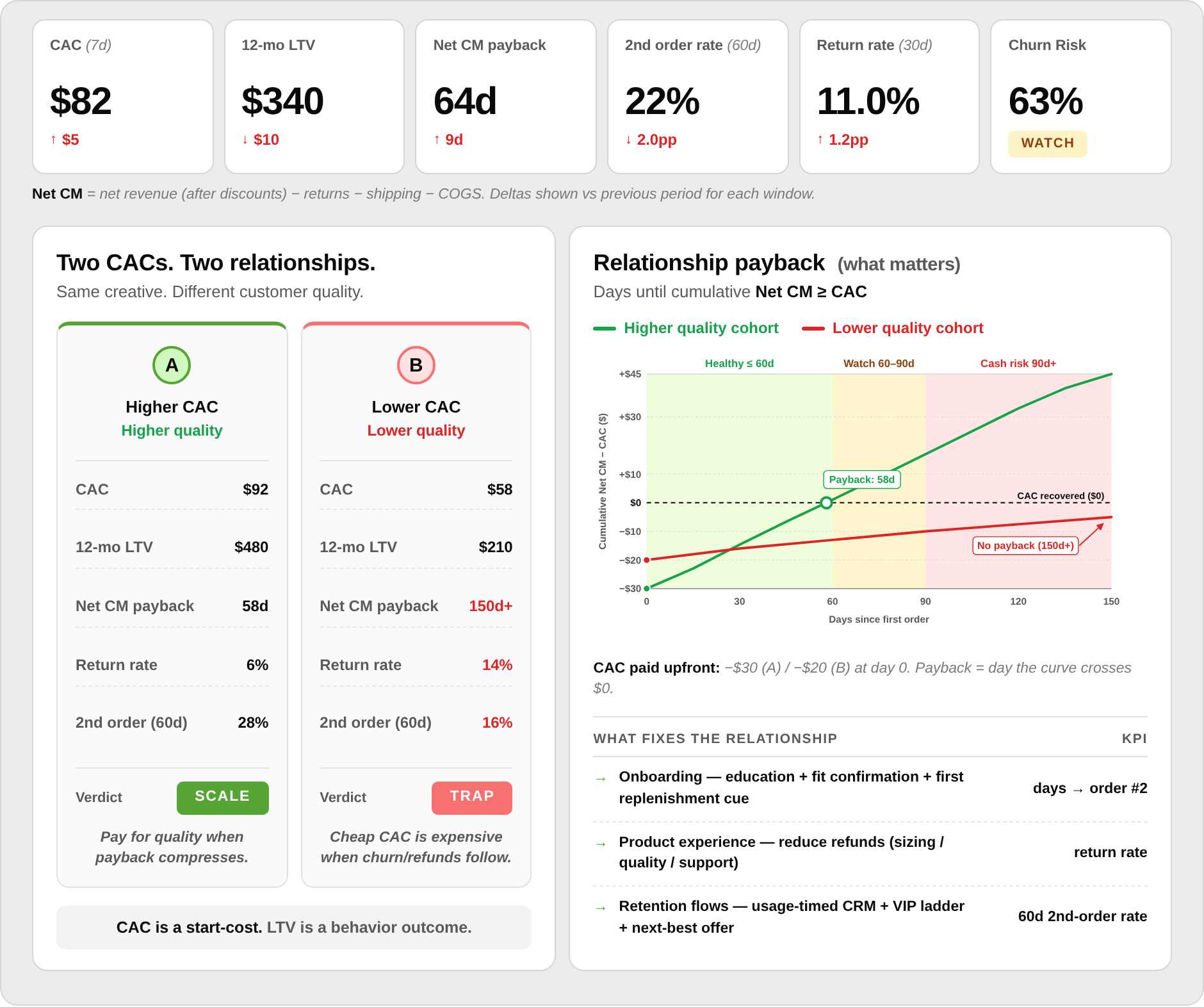
A cheap first date doesn’t matter if the relationship fails.
Most brands treat CAC like a report card and LTV like a slide in a deck. But financially, the relationship is the business: CAC is the upfront investment, and LTV is the stream of net contribution margin you earn if the customer actually sticks. A low CAC is not a win if the customer churns after order #1 or refunds half the cart. A slightly higher CAC can be a bargain if it buys a cohort that repeats, returns less, and pays back fast.
The story: two CACs, two futures
A CMO tells the team: “We need CAC down.”
So the team optimizes for cheaper conversions: broader audiences, cheaper entry products, heavier promos. CAC drops. Everyone celebrates.
Then finance asks the only question that matters:
“Did payback improve?”
Because what changed wasn’t efficiency — it was customer quality. The cheaper CAC cohort did three things:
Lower second-order rate (they didn’t become customers, they became transactions)
Higher returns (the product didn’t match expectation or intent)
Longer payback (if payback happens at all)
This is the trap: you can lower CAC and still make the business worse. Not because CAC is irrelevant — but because you optimized the wrong thing.
The CEO metric isn’t CAC. It’s relationship payback.
If you want one metric that connects marketing to the P&L, it’s this:
Net CM payback = days until cumulative net contribution margin ≥ CAC.
Net contribution margin means after:
If your payback doesn’t compress, performance didn’t improve. Full stop.
That’s why the best operators don’t obsess over “CAC down.” They obsess over payback down and cohort quality up.
5 principles that change how you run growth
CAC is a start cost. LTV is a behavior outcome.
You can buy the first order. You can’t buy the second order without consequences. LTV is created by the relationship: product experience, onboarding, timing, and trust.
Cheap CAC can be expensive when churn and refunds follow.
If a cohort has high refund rate or low second-order rate, your “efficient” CAC is just a delayed loss. The P&L will always catch up to bad customer quality.
Higher CAC is fine when the cohort pays back fast.
Paying $92 CAC for a cohort that repays in 58 days is a better business than paying $58 CAC for a cohort that never pays back. CEOs should be buying cash-safe payback, not cheap clicks.
Your “best campaign” is the one that manufactures high-quality cohorts, not the one that wins day-1 ROAS.
Day-1 ROAS is a transaction metric. Cohort payback is a business metric. Your winners should be judged on net CM payback, repeat rate, and return rate.
The relationship breaks in three places: onboarding, product experience, and retention sequencing.
If customers don’t understand how to use the product, they churn. If the product disappoints, they refund. If your retention is static and irrelevant, they forget you. This is where LTV is either earned or destroyed.
|
✓
|
|
The Operator Playbook
|
| What to actually do |
| Five operator moves to turn CAC into a payback discipline — not a vanity number. |
|
|
|
|
Replace “CAC target” with a “payback target.”
Set a simple rule, then run every major channel and campaign against it:
| • |
Healthy: ≤ 60 days payback |
| • |
Watch: 60–90 days |
| • |
Cash risk: 90+ days |
CAC alone doesn’t price growth — payback does.
|
|
|
Track three cohort-quality KPIs alongside CAC.
For each acquisition cohort, monitor:
| • |
Net CM payback (days) |
| • |
60-day second order rate |
| • |
30-day return rate |
If any of these move the wrong way, your “CAC win” is probably fake.
|
|
|
Stop letting the cheapest product become your acquisition hero.
Many brands accidentally acquire on the lowest-priced SKU because it converts easiest. But if that SKU creates low-LTV customers, you’re training the business to attract churn.
Acquisition should lead with products that create repeat behavior — not just first-order conversion.
|
|
|
Treat onboarding like a payback accelerator.
The goal of onboarding is not brand storytelling. It’s reducing uncertainty:
| • |
How to use the product |
| • |
What “good results” look like |
| • |
How to choose the right next product |
Better onboarding increases second-order rate and reduces refunds — which compresses payback.
|
|
|
Build a second-purchase engine, not a discount calendar.
Your retention flows should be timed to behavior, not arbitrary “7 days later.” Use replenishment windows and next-best-offer logic so the customer sees the right product at the moment they’re actually ready.
This is how you turn “slightly higher CAC” into a profitable relationship.
|
|
|
BOOK YOUR AUDIT →
|
|
The punchline
A cheap first date doesn’t matter if the relationship fails.
CAC is the invitation. LTV is the relationship. If you want sustainable scaling, stop optimizing for lower CAC in isolation and start optimizing for cohort quality and payback compression. That’s how older cohorts fund newer ones, discounts become optional, and growth stops feeling fragile.
|
Reader questions
|
| Ask me anything. |
| Smart questions from operators in my inbox — my honest answers. |
|
|
What’s the first relationship KPI? |
|
|
|
|
Alex says · Founder RetentionX |
|
| For most brands it’s time-to-second-order and 90-day profit per new customer (CM1). Those two tell you quickly whether the relationship is deepening and whether it’s doing so profitably. Engagement metrics are useful, but they’re proxies. The business KPI is: do they come back, and does it pay? |
|
|
|
If you had to pick the 2–3 most predictive early indicators of “fan potential” within the first 30 days, what would they be? (time-to-2nd-order, product engagement, support tickets, returns initiated, review rate, etc.) |
|
|
|
|
Alex says · Founder RetentionX |
|
| Top signals: returns initiated / refund rate, support burden, and early repeat intent (time-to-2nd-order or “next purchase” behavior). If customers are immediately returning, complaining, or needing lots of support, the relationship is fragile regardless of CAC. If they engage and come back quickly without heavy discounting, that’s fan potential. I also like review/UGC as a strong qualitative signal when volume allows. |
|
|
|
How do you draw the line on “high CAC is fine”? Do you set channel-specific payback windows, or is it more about cohort CM1 at 90 / 180 days? |
|
|
|
|
Alex says · Founder RetentionX |
|
| Both, but I anchor on payback in contribution margin at 90 / 180 days and then set channel-specific ceilings from that. High CAC is fine when the cohort curve shows fast recovery and strong profit growth over time. If CAC is high and payback keeps stretching, you’re funding growth with hope. The discipline is: higher CAC requires higher cohort quality, proven consistently — not a story. |
|
|
|
For categories with naturally low repeat (high-consideration, long replacement cycle), what does “don’t screw up the relationship” translate to? Is the equivalent milestone referral/UGC, warranty registration, accessories, something else? |
|
|
|
|
Alex says · Founder RetentionX |
|
| In long-cycle categories, the “relationship” is measured by second commitments, not second purchases. Think warranty registration, reviews/UGC, referrals, accessory attach, service plans, and low support friction. Those are early signals of satisfaction and future intent even if the next big purchase is far away. You’re building a base that will come back when the timing is right — and will bring others with them. |
|
|
|
When you say Marketing Intelligence solves this, what’s the practical mechanism — do you feed platforms higher-LTV signals, or is it more about giving teams a cohort-level truth so they stop scaling the wrong channels? |
|
|
|
|
Alex says · Founder RetentionX |
|
| Both — first you need cohort-level truth so teams stop rewarding channels that look good short-term but create weak customers. Then you translate that into action: budget allocation, bid ceilings by channel, and better signals/audiences that align platforms with profitable customer creation. The “solve” isn’t a magic dashboard — it’s closing the loop between acquisition and long-term outcomes. Once you can see which spend creates durable profit, you can actually scale with confidence. |
|
|



 Listen on Spotify