|
|
|
…12,852 founders and ecommerce operators are reading this newsletter today…
|
LTV is an Ops Metric
Most teams treat LTV as a finance number: revenue per customer over time. That's too narrow. The customers you attract don't just affect what you earn. They determine what it costs to run your business.
A bad customer mix shows up everywhere: in support queues, in return volumes, in warehouse exceptions, in finance escalations, in leadership meetings. Low-quality acquisition isn't just a marketing problem. It's organizational debt that compounds quietly across every department.
Operational Leverage · Cost-to-Serve
Retention doesn’t just grow revenue
— it reduces chaos.
When customer quality rises, revenue goes up — and operational chaos goes down. Fewer tickets, fewer returns, fewer refunds → more time for improvements and upsell.
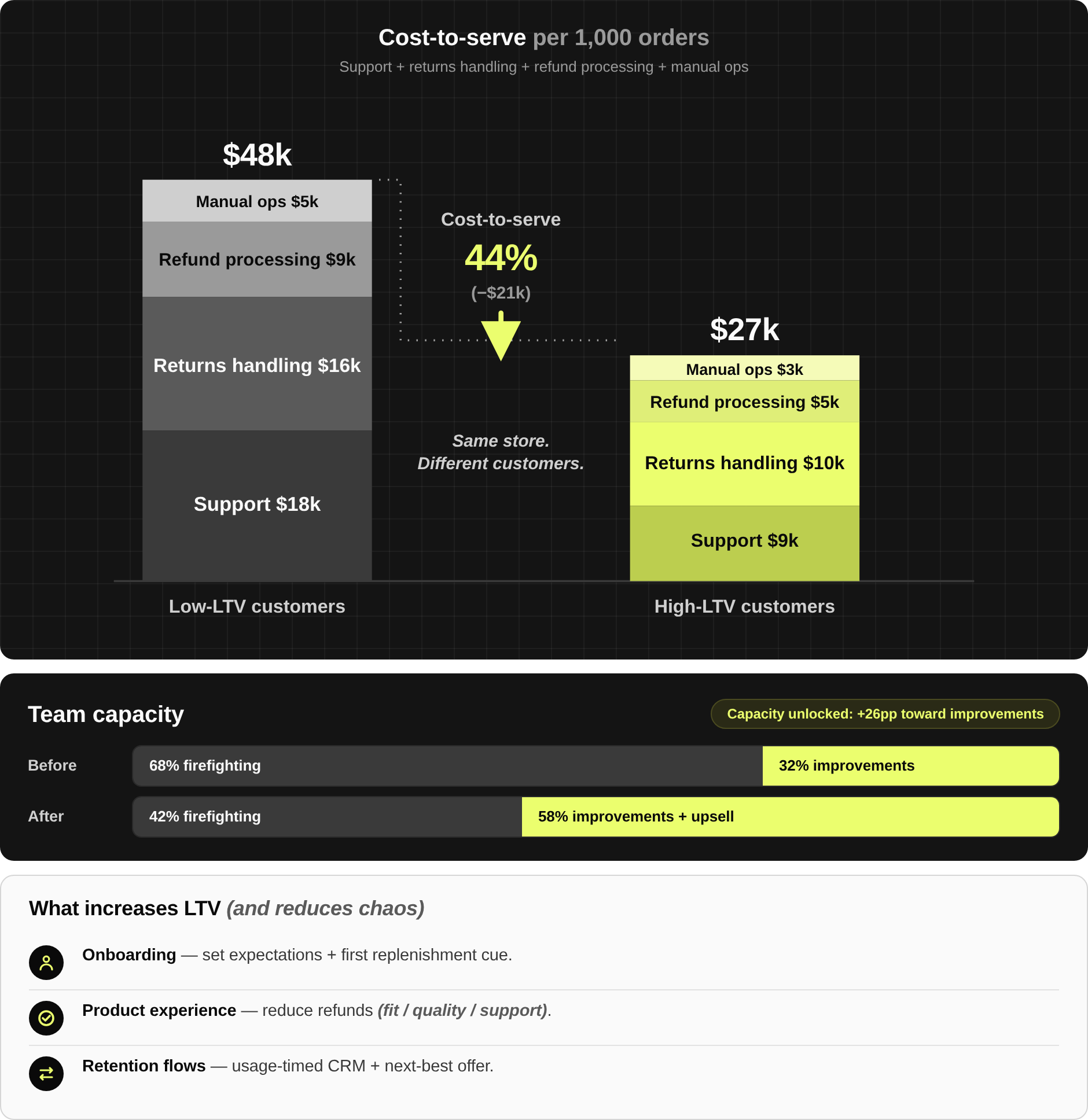
High LTV isn’t just growth — it’s operational leverage.
The Jekyll and Hyde of Customer Files
Consider two versions of the same brand: same website, same fulfillment setup, same support team, same 1,000 orders. The only difference is the customer mix.
Version one is attracting low-LTV customers. More fit-related returns, more refund requests, more customer support tickets, more manual exceptions, more price-sensitive behavior that creates edge cases at every step. Cost-to-serve for those 1,000 orders: around $48,000. About 68% of the team's time is spent firefighting.
Version two attracts higher-LTV customers. Fewer returns, fewer escalations, fewer tickets, more predictable repeat behavior. Cost-to-serve for the same 1,000 orders: around $27,000. Team time spent firefighting drops to 42%.
That's a 44% reduction in operational drag with identical order volume. And the time that gets freed up doesn't disappear, it gets reallocated to retention, merchandising, strategy improvements, and the work that actually builds the business.
High LTV is not just growth. It's operational leverage.
Changing how you think about LTV and Ops
LTV is partly a cost-to-serve metric. A customer who buys again, returns less, and contacts support less isn't just more valuable because they generate more revenue. They're more valuable because they're cheaper to serve. That means LTV is shaped by both what customers spend and how much operational chaos they create.
Bad-fit customers make the whole company noisier. The wrong cohorts don't just hurt marketing efficiency. They flood support, inflate return handling, increase refund processing, and create more manual ops work. You feel them everywhere — in Slack, in your ticketing system, in the warehouse, in the P&L. Low-quality acquisition is organizational debt.
Retention work reduces chaos upstream, not just churn downstream. Better onboarding, better product expectations, better next-offer logic, better replenishment timing, these aren't lifecycle tactics. They reduce confusion and friction before it surfaces as tickets and returns. Retention is about creating customers who are easier to serve, not just customers who come back.
Support capacity is a growth lever. If the team is spending the majority of its time on preventable issues, the business is being starved of improvement work. Better customer files don't just drive more revenue, they create the space to make the machine better.
|
✓
|
|
The Operator Playbook
|
| What to change this quarter |
| Five operator moves to turn retention into operational leverage, not just revenue. |
|
|
|
|
Add cost-to-serve to your LTV conversation.
Don't stop at revenue, CM1, and repeat purchase rate. Start tracking by cohort: support tickets per 100 orders, return rate, refund rate, manual intervention rate, and cost-to-serve per 1,000 orders. Once those sit next to LTV, a lot of "good growth" starts looking different.
|
|
|
Find the customer sources creating the most drag.
Ask a direct question: which cohorts create the most tickets, exchanges, refunds, and manual work relative to the revenue they generate. Look at acquisition channel, first-purchase product, discount exposure, and customer type to understand where exactly you are filling your funnel with bad customers.
|
|
|
Fix onboarding before adding more volume.
Most operational chaos starts with mismatched expectations. Better product education, sizing clarity, usage guidance, and first replenishment cues increase repeat rate and reduce support burden.
|
|
|
Use retention flows to reduce friction, not just push offers.
Broad discounts bring customers back while often preserving the same behaviors that created the drag in the first place. Usage-timed replenishment, next-best-offer logic, and proactive communication before confusion turns into a ticket, that's what makes the second order smoother than the first.
|
|
|
Protect team capacity like it's margin.
Because it is. Reducing chaos redirects time toward upsell conversations, product improvements, VIP treatment, and more intelligent retention work. That's how better customer quality compounds beyond the P&L.
|
|
|
BOOK YOUR AUDIT →
|
|
The Takeaway
When LTV goes up, the whole company gets easier to run. That's why LTV isn't just a finance metric. It's one of the clearest operating signals in the business.
-Alex
|
Reader questions
|
| Ask me anything. |
| Smart questions from operators in my inbox. Honest answers from the founder of RetentionX. |
|
|
How do you actually measure “chaos”? |
|
|
|
|
| Start with cost-to-serve per 1,000 orders, split by cohort, channel, and first-purchase SKU. Underneath that, track tickets per 100 orders, return rate, refund rate, reship rate, and any manual intervention your ops team can quantify. Then compare those against CM1, LTV90, and payback. If service burden is rising faster than customer value, that cohort is creating chaos, not leverage. |
|
|
|
In a category like apparel where returns are structurally high, do you benchmark against category norms or just look at internal differences? |
|
|
|
|
| Use category norms as a sanity check, not a decision framework. The more useful view is internal variance — which cohorts are materially worse than your own baseline. High returns are normal in apparel; avoidable returns are the problem. If one first SKU, one offer type, or one channel produces meaningfully worse economics than the rest of your business, that's where to act. |
|
|
|
For subscription brands, does the drag come more from bad customer quality or from cadence mismatch? |
|
|
|
|
| Both matter, but cadence mismatch is often the silent amplifier. A good customer becomes expensive fast if the product arrives too early, inventory piles up, and the relationship shifts from convenience to irritation. To tell them apart, look at skip, pause, and cancel behavior alongside ticket volume and timing. If the pain starts after the second or third shipment, it's usually cadence. If it starts immediately, it's acquisition quality or expectation mismatch. |
|
|
|
What explains service burden better — acquisition channel, or the first product the customer bought? |
|
|
|
|
| Usually the first product and offer type explain more than channel alone. The channel buys the customer, but the product and offer teach them what kind of relationship this is going to be. That said, the real answer is in the combination: channel × first SKU × discount logic. That's the view that shows which acquisition paths create revenue and which create operational drag. |
|
|
|
Would you ever take on a noisier, lower-quality cohort to learn a new channel or geo faster? |
|
|
|
|
| Yes — but only as a time-boxed learning investment, never as scalable growth. That means explicit guardrails: a spend cap, a payback ceiling, a max refund rate, and a clear stop-loss if the cohort doesn't improve. Isolate it so it doesn't contaminate your broader acquisition or CRM logic. Learning can be expensive and still be rational, but only when it stays intentional. |
|
|





 Listen on Spotify