

PlantPaper makes bamboo toilet paper and tissue — a direct-to-consumer alternative to the mass market brands that have dominated bathroom shelves for decades. Lee founded the company in 2019. Five years later, he’s running one of the most retention-efficient businesses in DTC, on two products, with no outside capital.
Most founders who talk about retention economics talk about them like they were always part of the plan. Lee Reitelman is more honest than that.
When PlantPaper launched in late 2019, Lee had no subscription model, no LTV framework, no CAC target, and no real sense of what the cohort data would eventually show. What he had was a conviction that people would pay for a more sustainable, superior product — and the good fortune of launching six months before a global pandemic cleared every shelf in America.
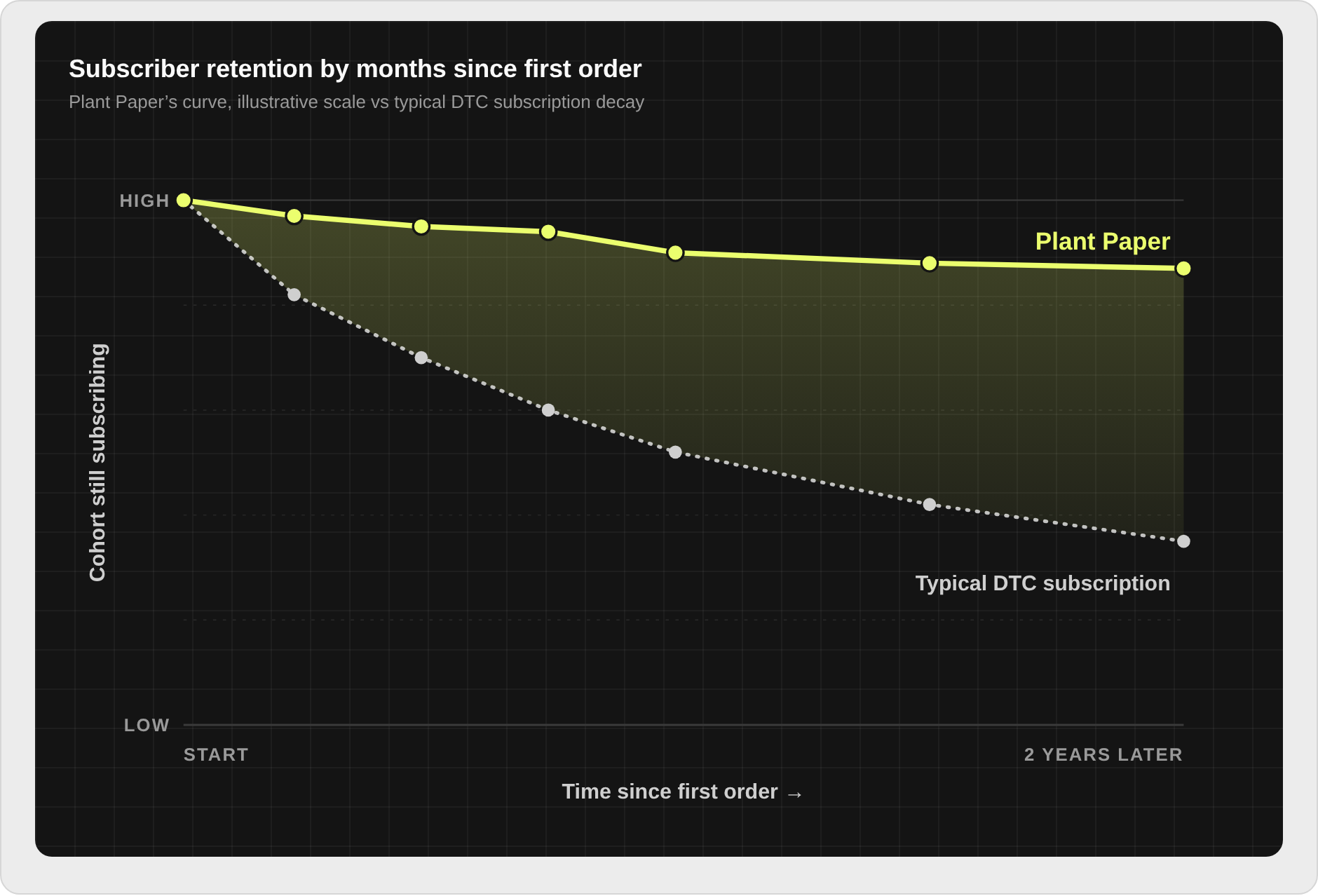
COVID brought a surge of panic buyers. What it left behind — when the dust settled and the subscriptions started recurring — was something Lee hadn’t expected: a retention curve that bordered on extraordinary. Ninety-five percent of those early cohorts were still subscribing six months later. Ninety percent at twelve months. At twenty-four months, the numbers were still holding.
The retention curve
they didn’t expect.
An exceptional curve, hidden in the cohorts that came through COVID. Almost no decay where a typical DTC subscription bleeds out.
The problem was that the business was losing money on every one of them. Freight costs had gone from $3,000 a container to $20,000. Prices hadn’t moved. The longer the retention held, the worse the economics got.
“That tension — exceptional retention, broken unit economics — is what forced the discipline. And it’s what makes Lee’s story worth reading carefully.”
What follows is an edited version of our conversation.
ALEX – You launched in 2019 without modeling LTV or retention. When did that change?
LEE – The first two years were basically a giant beta test to understand: do people like the product, and do people stick with it? Once we answered those questions, it was like, okay, let’s understand what it looks like when we acquire the average new customer over six, twelve, eighteen months.
We’d been spending maybe five or six thousand dollars a month on Meta, more or less fruitlessly, trying to figure out how to acquire customers. Then COVID hit, and a lot of those buyers stuck. By early 2021, we had eighteen to twenty-four months of data on some of these cohorts, and we still had ninety-plus percent retention. That’s when I really started to say, there’s something here.
The turning point was when I asked our media buyer a question he couldn’t answer: when we spend money on Meta, how should we think about the difference between acquiring a subscriber and a single purchaser? That question led me to Peter Shapiro, a direct response marketer who goes back to mail order catalogs in the eighties. He came in, looked at the business, and said: your retention is incredible. Let’s model what lifetime value actually looks like.
So I spent hundreds of hours manually tying email addresses to orders, building cohorts, looking at repeat purchase rates and margins on those repeat purchases. And that’s when everything changed.
ALEX – What changed specifically?
LEE – Up until that point, I thought about hanging up the skates every day. I felt like I was operating blind. We knew we had a good product. We knew people liked it. But I had no guardrails for decision-making. It was just instinct.
And then suddenly it wasn’t. You create a structure for decision-making that you can actually wrap your arms around. The math tells you: this is affordable, this is not, this is your target. As long as you hit that target, you can continue to scale. It gives you goalposts. It gives you something to run toward as a marketer, as a strategist.
Otherwise you’re just operating on hope.
ALEX – You reset prices significantly once you had the data. What did you find when you looked at retention on the new, higher-priced cohorts versus the old ones?
LEE – The repeat purchase behavior was essentially no different. People who came in at forty percent higher prices retained at the same rate as the ones paying less. That was the beginning of PlantPaper in its current form.
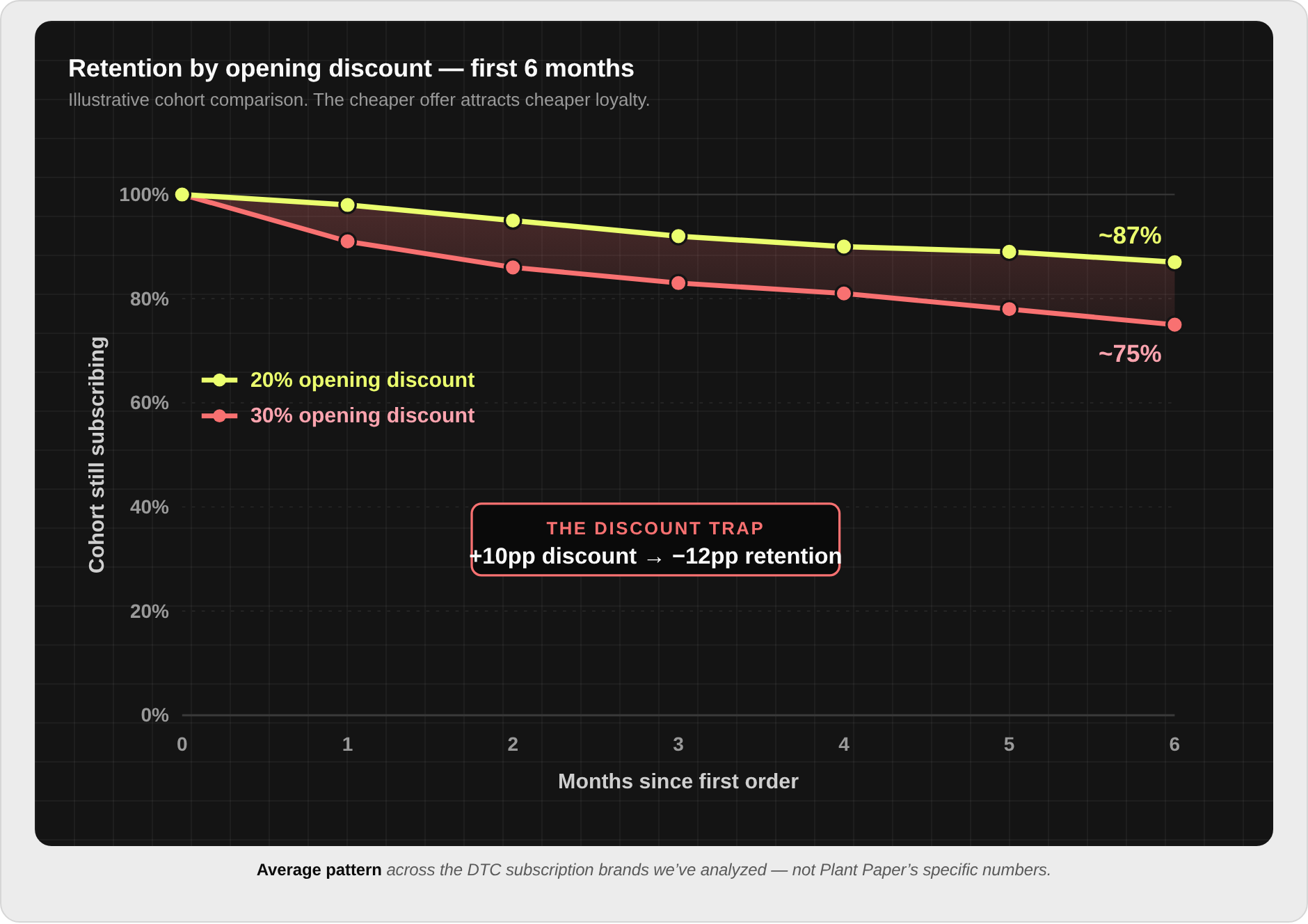
It also taught us something important about discounting. We’d done fairly substantial Black Friday discounts on subscriptions early on, and what we saw six, twelve months later was that LTV on those cohorts was terrible relative to our regular cohorts. The difference between a twenty percent opening discount and a thirty percent was massive. At six months, the twenty percent cohort might have eighty-seven percent retention. Those who came in at thirty percent: seventy-five. That’s a huge difference.
Big discounts drive short-term spikes. We’ve always been playing the long game.
Every discount point
trains a different customer.
A 10pp swap in opening discount → a 12pp gap in 6-month retention. Same brand. Same product.
ALEX – You’ve scaled to a meaningful size on two products. Most brands feel like they need twenty SKUs to get there. Was the discipline intentional?
LEE – The signals were so strong in terms of subscriber retention that we felt like: these people really love this product, they trust this brand, we cannot screw it up. It was clear something special was happening, and we felt strongly that throwing products at them for the sake of a short-term boost would dilute that trust.
Our product rule has always been: never introduce something that feels like a trade-off. It has to feel like a trade-up over what already exists in the market. That in itself becomes the governor on how many products you can introduce. Paper towel is the ultimate example — we could have launched four years ago, probably increased LTV by twenty percent quickly. But what was out there wasn’t good enough. So we did it the hard way. Four years later, we’re bringing it to market and we feel genuinely proud of it.
Lightning round. High CAC or low LTV?
High CAC. Easier to solve. Low LTV probably means you have a product problem. If the product is really great, your LTV should be at least decent.
ALEX – DTC only or multichannel?
LEE – DTC only, at least to start. It’s the only thing I have real chops in. Direct-to-consumer is an extraordinary proving ground — for brand, for marketing, for discipline around growth. A lot of companies go wrong by trying to do too much too quickly.
ALEX – First-time purchaser with no intention of subscribing, or a subscriber you know you won’t retain past four months?
LEE – Give me the subscriber. On average, even a bad subscriber gets to three and a half orders by the end of the first year. And honestly, getting single purchasers to subscribe is not easy. Getting somebody who comes in as a subscriber to stay — if you’ve got a good product and you treat them transparently — is considerably more achievable. We’re still figuring out the single-purchaser-to-subscriber conversion every day.
The Takeaway
PlantPaper is available at plantpaper.com. The paper towel launches soon.
What strikes me most about PlantPaper is that the retention was always there — Lee just needed the framework to see it, and the discipline not to destroy it chasing short-term revenue. That’s a harder balance to strike than it sounds.

 Listen on Spotify