Customer Quality · RFM Map
Who are your VIPs, actually?
RFMRecency · Frequency · Monetary value
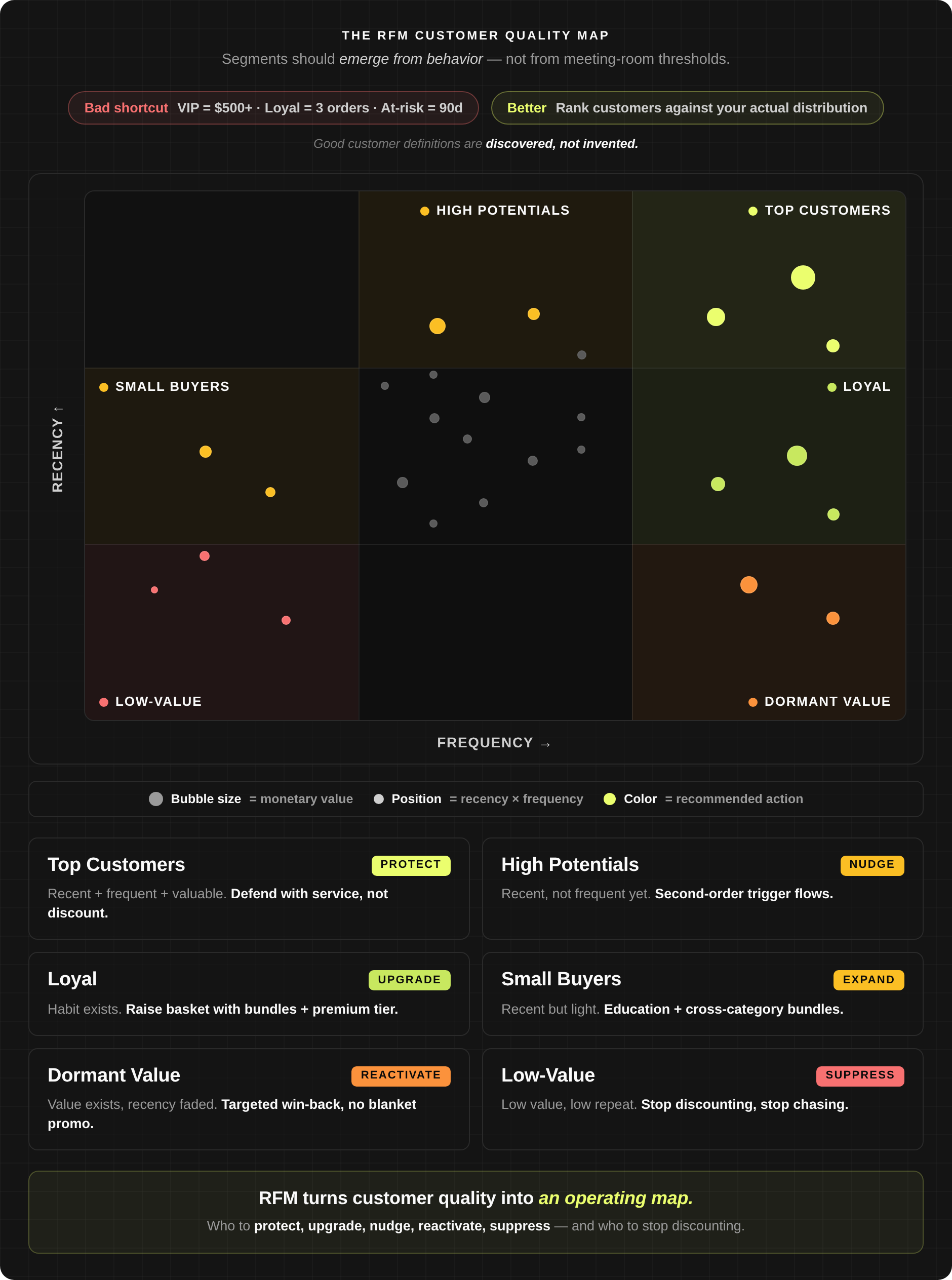
Most brands make customer segmentation too complicated – or worse, too arbitrary. They define "VIP" as "3+ orders" or "$300+ spent" because it sounds reasonable, then build campaigns, perks, and budget logic around thresholds that may have nothing to do with the actual shape of the customer base. That’s expensive, because if you misread customer quality, you misallocate retention effort, promo margin, paid audiences, and service levels.
The mistake: inventing customer segments in a meeting
Here’s a situation I see constantly.
A brand wants to get more serious about retention. So the team creates a few segments:
VIP customers: $500+ spent
Loyal customers: 3+ orders
At-risk customers: no order in 90 days
Low-value customers: under $100 spent
It feels clean. It makes sense in a slide. Everyone nods.
But then you look at the real customer file and the thresholds are off.
Maybe $500 is not "VIP" for this brand – maybe it’s just the top 35%.
Maybe 3 orders is not loyal – maybe most good customers buy 5–6 times.
Maybe 90 days inactive is not at-risk – maybe the normal time between purchases is 140 days.
Maybe some customers with only 2 orders are actually incredibly valuable because their AOV and margin are high.
The problem is not that the team is lazy.
The problem is that they are defining customer quality before looking at the actual distribution of the customer base.
That’s where RFM is so useful.
The Commerce 101 version of RFM
Recency: how recently did the customer buy?
Frequency: how often do they buy?
Monetary value: how much value have they generated?
Simple enough for a Monday meeting.
But powerful because it gives you a behavior-based map of your customers without needing a six-month data science project.
Instead of asking, "What do we think a good customer is?" RFM asks:
Who is good relative to the rest of our customer base?
Because RFM is not built on random thresholds. It ranks customers against your own reality. It shows who is recent, frequent, and valuable – and who is not.
5 principles that change how you should think
Good customer thresholds should be discovered, not invented.
A $300 customer can be amazing for one brand and average for another. Three orders can signal loyalty in one category and barely mean anything in another. RFM stops you from applying generic assumptions to a specific business.
Recency keeps you honest.
A customer who spent a lot two years ago is not the same as a customer who bought last week. Monetary value tells you what happened historically. Recency tells you whether the relationship is still alive.
Frequency shows habit.
Frequency is often the clearest signal that your brand has become part of the customer’s routine. A high-AOV one-time buyer might be interesting, but a frequent buyer is proving repeat trust.
Monetary value adds economic weight.
Not all frequent customers are equally valuable. Some buy often but small. Others buy less often but with high contribution margin. Monetary value helps separate activity from actual business impact.
RFM is not just segmentation. It’s an action map.
The point is not to label customers. The point is to decide what to do with them: who to protect, who to upgrade, who to reactivate, who to exclude, and who to stop discounting.
|
✓
|
|
The Operator Playbook
|
| What to actually change |
| Five operator moves to turn RFM from a CRM tag into a cross-functional operating map. |
|
|
|
|
Run an RFM view before defining any “VIP” or “loyal” cohort.
Don’t start with fixed thresholds. Start with the distribution. Look at the top groups and ask:
| • |
How recent are they? |
| • |
How often do they buy? |
| • |
How much CM1 / net revenue do they generate? |
| • |
What products did they start with? |
| • |
What channels brought them in? |
The answers tell you what a VIP actually looks like in your store — not what the team agreed to in a meeting.
|
|
|
Turn RFM groups into clear operating actions.
A simple playbook by archetype:
| • |
Top Customers: protect them — avoid unnecessary discounts, give early access or better service |
| • |
Loyal Customers: move them toward higher-value products or VIP status |
| • |
High Potentials: push the next logical purchase before they drift |
| • |
Small Buyers: test education, bundles, or category expansion |
| • |
Dormant Customers: reactivate selectively, not with blanket promos |
| • |
Worst Customers: stop wasting promo margin and paid retargeting on them |
|
|
|
Use RFM across more than email.
Most teams stop too early and only use RFM for CRM campaigns. The real leverage is cross-functional:
| • |
Paid: build lookalikes from top / loyal customers |
| • |
Retention: personalize flows by customer state |
| • |
Support: prioritize high-value or high-potential customers |
| • |
Merchandising: understand which products create top customers |
| • |
Promotions: suppress discounts for customers who don’t need them |
|
|
|
Layer RFM with profitability.
RFM tells you behavior. For serious operators, behavior needs to meet economics. Add:
| • |
CM1 |
| • |
Return rate |
| • |
Discount dependency |
| • |
Product mix |
| • |
Payback |
That’s how you avoid treating a frequent but low-margin, high-return customer as “good.”
|
|
|
Review the RFM mix over time.
The question isn’t just “who are our top customers today?” It’s: is the customer base becoming healthier?
| • |
Are Top and Loyal segments growing? |
| • |
Are High Potentials converting? |
| • |
Are Dormant and Low-Value groups expanding? |
| • |
Is acquisition creating more future top customers — or just more one-time buyers? |
Track the mix quarter-over-quarter. That’s the real growth scoreboard.
|
|
|
BOOK YOUR AUDIT →
|
|
The takeaway
RFM works because it gives you a simple, behavior-based language for customer quality. It replaces arbitrary thresholds with a real map of how your customer base actually behaves.
For 8–9 figure brands, the leverage is not in "having segments." The leverage is in using those segments to run the business differently: better CRM, smarter paid audiences, cleaner promo logic, stronger support prioritization, and healthier long-term LTV.
Before you build a more complex retention strategy, make sure you understand the basic structure of your customer base. RFM is usually the best place to start.
The takeaway
When LTV goes up, the whole company gets easier to run. Fewer returns, fewer refunds, fewer support escalations, fewer manual edge cases – and more time to do the work that actually improves the business. That is why LTV is not just a finance metric. It is one of the clearest operating signals in the company.
If you want healthier scaling, stop treating retention as a post-purchase revenue tactic. Treat it as a way to improve customer quality, reduce chaos, and create operational leverage across the whole business.
|
Reader questions
|
| Ask me anything. |
| Smart questions from operators in my inbox — my honest answers. |
|
|
How often should RFM refresh? |
|
|
|
|
Alex says · Founder RetentionX |
|
| For most brands, monthly is enough for strategic planning — but the action segments should update much more frequently, ideally daily or weekly. Recency changes fast, especially for lapsing, in-market, and second-order opportunity segments. You don’t want to wait a month to catch someone moving from “high potential” to “at risk.” The rule: strategy monthly, activation continuously. |
|
|
|
Do you recommend fixed thresholds, or ranking customers against the actual distribution? |
|
|
|
|
Alex says · Founder RetentionX |
|
| Strongly prefer ranking against the brand’s actual distribution. Fixed thresholds like “VIP = $500+” sound clean, but they often have nothing to do with the shape of the customer file. In one brand, $500 might be normal; in another, it’s elite. RFM works best when the segments emerge from behavior — not from a meeting-room guess. |
|
|
|
How do you layer margin into RFM? |
|
|
|
|
Alex says · Founder RetentionX |
|
| RFM is the starting map, not the full truth. Layer in CM1, returns, discount dependency, and support friction to separate high-revenue customers from genuinely high-quality customers. A customer who spends a lot but returns half the order or only buys with 30% off should not be treated like a clean VIP. The best version is RFM + profit quality. |
|
|
|
What’s the first campaign you’d change after building an RFM map? |
|
|
|
|
Alex says · Founder RetentionX |
|
| Usually promo suppression and second-order nudges. Protect your best customers from unnecessary discounts, and move high-potential first-time buyers toward order two with relevant product journeys. Those two moves improve margin and retention quickly without a big rebuild. After that, look at paid audiences: exclude low-value segments and seed lookalikes from genuinely high-quality customers. |
|
|
|
How do you prevent teams from overcomplicating this? |
|
|
|
|
Alex says · Founder RetentionX |
|
| Tie every segment to one job. If a segment doesn’t have a clear action — protect, upgrade, nudge, reactivate, suppress — it probably doesn’t need to exist. The goal isn’t a beautiful segmentation model. It’s better decisions across CRM, paid, service, and merchandising. Six segments the team uses every week beats thirty segments nobody trusts. |
|
|



 Listen on Spotify