
The treadmill nobody wants to admit
How much of this month’s revenue had to be bought again from scratch?
to "How do we build a base?"
Most brands know how much revenue they generated this month. Far fewer know how much of that revenue depended on acquiring brand-new customers all over again. That distinction matters because a business can grow revenue while becoming more fragile, more cash-hungry, and more dependent on paid acquisition every month.
Imagine two brands doing the same monthly revenue.
On paper, they look similar.
Same topline.
Similar CAC.
Similar ad spend.
Similar conversion rate.
But under the surface, they are completely different businesses.
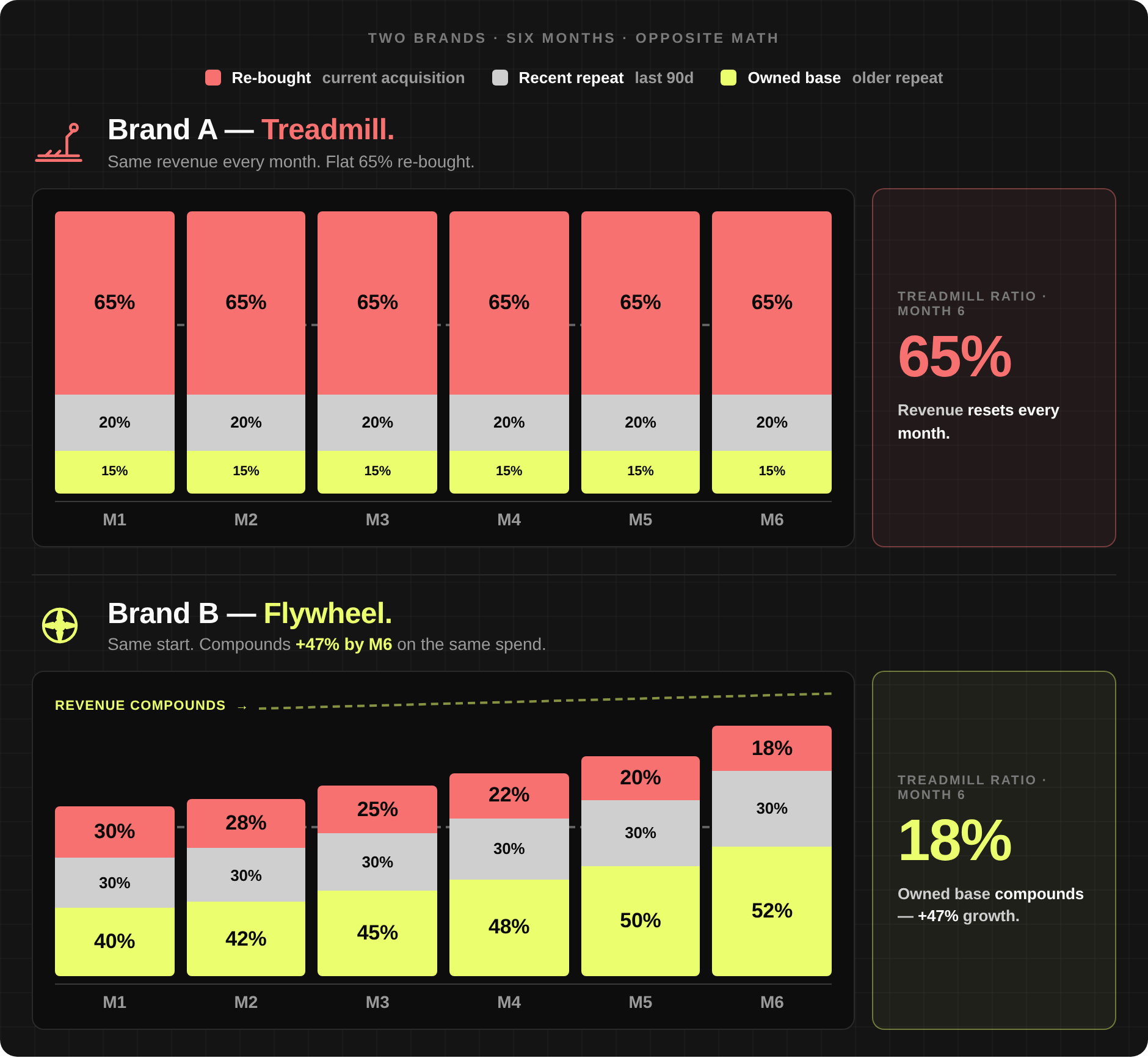
Brand A gets 65% of this month’s revenue from customers acquired this month. Another 20% comes from recent repeat buyers. Only 15% comes from older repeat customers.
The dashboards are moving.
New customers are coming in.
But every month starts almost from zero.
If CPMs spike, the month gets stressful.
If Meta softens, the month gets stressful.
If a campaign underperforms, the whole revenue plan starts shaking.
That’s not a flywheel.
That’s an acquisition treadmill.
Now look at Brand B.
Only 18% of revenue comes from current-month acquisition. 30% comes from recent repeat customers. 52% comes from older repeat customers.
New acquisition still matters. But it is not carrying the whole month.
Older cohorts are still producing.
Repeat revenue has become the floor.
The business has an owned base that supports growth instead of forcing every dollar to be re-earned from scratch.
That is the difference between a brand that is buying revenue and a brand that is building a customer asset.
The metric: Acquisition Treadmill Ratio
The question I’d put in every monthly exec meeting is simple:
What percentage of this month’s revenue came from customers acquired this month?
That’s your Acquisition Treadmill Ratio.
A simple definition:
Treadmill Ratio = % of monthly revenue from current-month acquisition
If that number is too high, the business resets every month.
You can still:
hit revenue targets
grow new customer count
show decent CAC
report solid ROAS
look “efficient” in-platform
…but structurally, you are exposed.
Because too much of the month depends on buying new demand again.
4 principles that change how you read growth
New customer revenue is not automatically good news.
A high share of revenue from new customers can mean you are scaling. But it can also mean your existing base is too weak to support the business. Without the repeat breakdown, you don’t know which story you’re looking at.
Repeat revenue is the revenue floor.
The more older cohorts contribute each month, the less pressure you put on acquisition. That gives the brand more room to manage CAC volatility, test new channels, and protect margin. Repeat does not just increase LTV – it lowers operational stress.
A flat treadmill ratio is a warning sign.
If you’re at 60–70% re-bought revenue month after month, the customer base is not compounding enough. You may be growing, but you are growing in a way that requires constant replacement. That is expensive growth.
The goal is not to stop acquisition. It is to make acquisition less responsible for survival.
You still need new customers. But new acquisition should sit on top of a stronger base, not replace it every month. The healthiest brands acquire to expand the base, not to refill what leaked out.
A business is not built when acquisition spikes.
A business is built when repeat becomes the base.
The Acquisition Treadmill Ratio forces you to see whether you are creating a customer asset or simply buying the same revenue back every month. When that ratio trends down, LTV becomes more durable, cash flow gets safer, and scaling starts to feel healthier.
Ask me anything.
Smart questions from operators in my inbox — my honest answers on the treadmill ratio.

It depends heavily on category and maturity, but for many scaled brands I’d start getting concerned if current‑month acquisition is consistently above 40–50% of monthly revenue in normal months. For younger brands that can be fine temporarily; for mature brands it usually means repeat revenue isn’t becoming a strong enough base. The trend matters more than one month. If the ratio isn’t moving down over time, you’re probably not building as much customer equity as the topline suggests.
Subscription renewals should count as base revenue because they reduce monthly fragility, but I’d split them out separately. Otherwise a brand can look stable while churn is quietly worsening underneath. I’d show three lines: revenue from new customers, revenue from repeat non‑subscription buyers, and revenue from subscription / auto‑replenishment. The healthy version isn’t just “less new revenue dependency” — it’s durable base revenue with strong survival and healthy CM1.
Seasonal spikes need to be judged against the right baseline. I’d compare the ratio to the same period last year and then watch what happens in the following 60–120 days. If November has a high treadmill ratio but those customers move into recent repeat and older repeat revenue later, that’s healthy acquisition. If they disappear, it was just seasonal volume — not a stronger customer base.
I’d start with the order 1 → order 2 system, because it’s usually the fastest way to change the mix. Then I’d look upstream at acquisition quality: which channels, entry SKUs, and offers are producing customers who never come back. Product mix matters too — some products simply don’t create a natural second purchase. The goal is to make repeat revenue a system, not a hope.
Yes — if people treat it as a metric to optimize in isolation. The point isn’t “less acquisition is always better.” The point is: acquisition should build a base that keeps producing. I’d pair the treadmill ratio with new‑customer volume, payback, and cohort CM1 so teams don’t starve acquisition just to make the mix look safer. Healthy brands still acquire aggressively — they just don’t depend on reacquiring the whole month from scratch.

 Listen on Spotify