
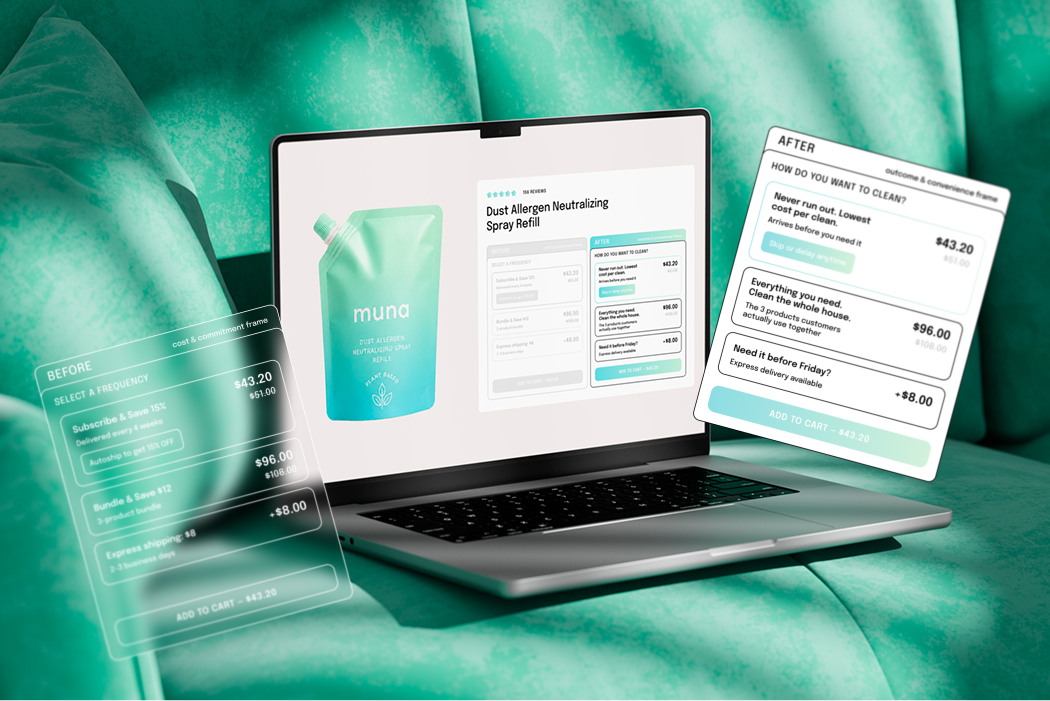
A brand changes nothing about its offer economics and increases subscription take rate. The only thing that moved was the frame around the offer.
Why? The frame you put around an offer determines what the customer notices first: price, commitment, risk, outcome, or convenience. Once that filter is set, the metrics that follow reflect it: subscription take rate, bundle attach, premium mix, cohort quality. Framing is upstream of all of it.
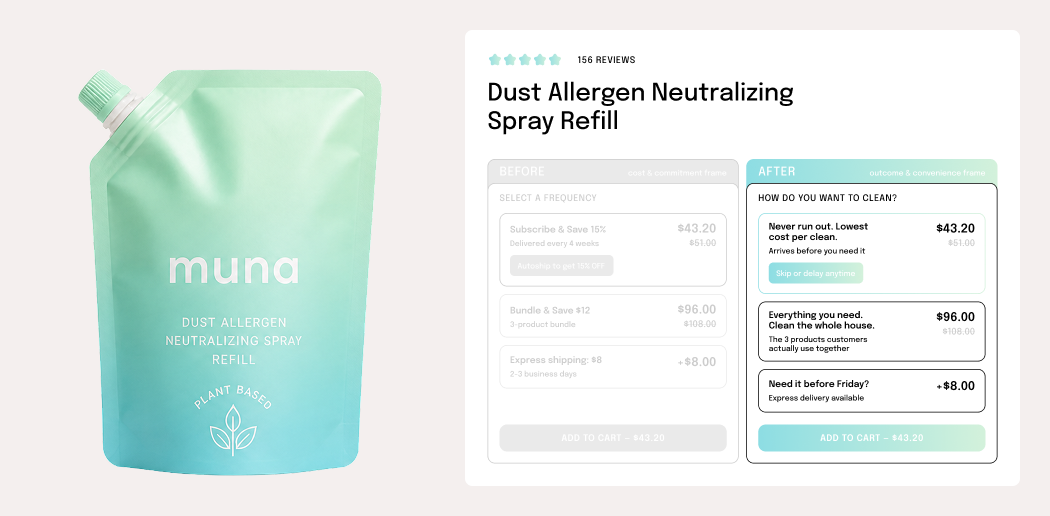
Take a brand selling home cleaning products: surface sprays, concentrates, refill bundles. Subscription take rate is weak. Customers default to a single bottle. Multi-product bundles are being ignored. Cancel save flows have become discount negotiations.
The instinct is to adjust the economics: richer subscription discount, lower bundle price, reconsider the premium tier.
But the economics here aren't the problem. The decision environment is.
Their offer stack currently reads:
Subscribe & save 15%
Bundle and save $28
Basic $49 / Pro $129
Express shipping: $18
Stay subscribed and save 10%
Every frame asks the customer to evaluate cost, commitment, and risk, so they choose the lowest commitment path, delay the bigger basket, treat cancel save like a coupon moment.
Now change nothing about the economics, only the framing:
Never run out. Lowest cost per clean.
Everything you need to clean the whole kitchen, together.
Start with one room / clean the whole house in 60 days.
Need it before Friday?
Skip, delay, or change frequency so it arrives when you need it.
Same offer. Different mental filter. Different behavior.
What to change this week
Audit your key offer surfaces for the mental filter they create. Subscription modules, bundle PDPs, tier comparisons, shipping language, cancel save flows. Ask: are we making the customer scan for price and risk, or for outcome and fit?
Run same-economics framing tests. Keep the offer fixed and test only the lens. "Subscribe & save 15%" versus "Never run out. Lowest cost per use." "Bundle and save $28" versus "Get the 3 products customers actually use together." Don't change the economics and the framing simultaneously, you won't know which variable moved the needle.
Measure downstream, not just conversion. Track subscription take rate, bundle attach, premium tier mix, and CM1 by entry path. A frame that produces slightly fewer conversions but better customers is still the superior business outcome.
Treat subscription cancellation flows as problem-solving, not reflexive discounting. Solve the operational objection instead: skip, delay, cadence change, product swap, without teaching the customer that threatening to cancel is the path to a discount.
The Operator Takeaway
For a sanity check on your own offer framing — where you may be accidentally pushing customers toward the cheapest, safest path — reply FRAME and I’ll tell you what I’d look at in your data first.
 Listen on Spotify