
The Hesitation Window
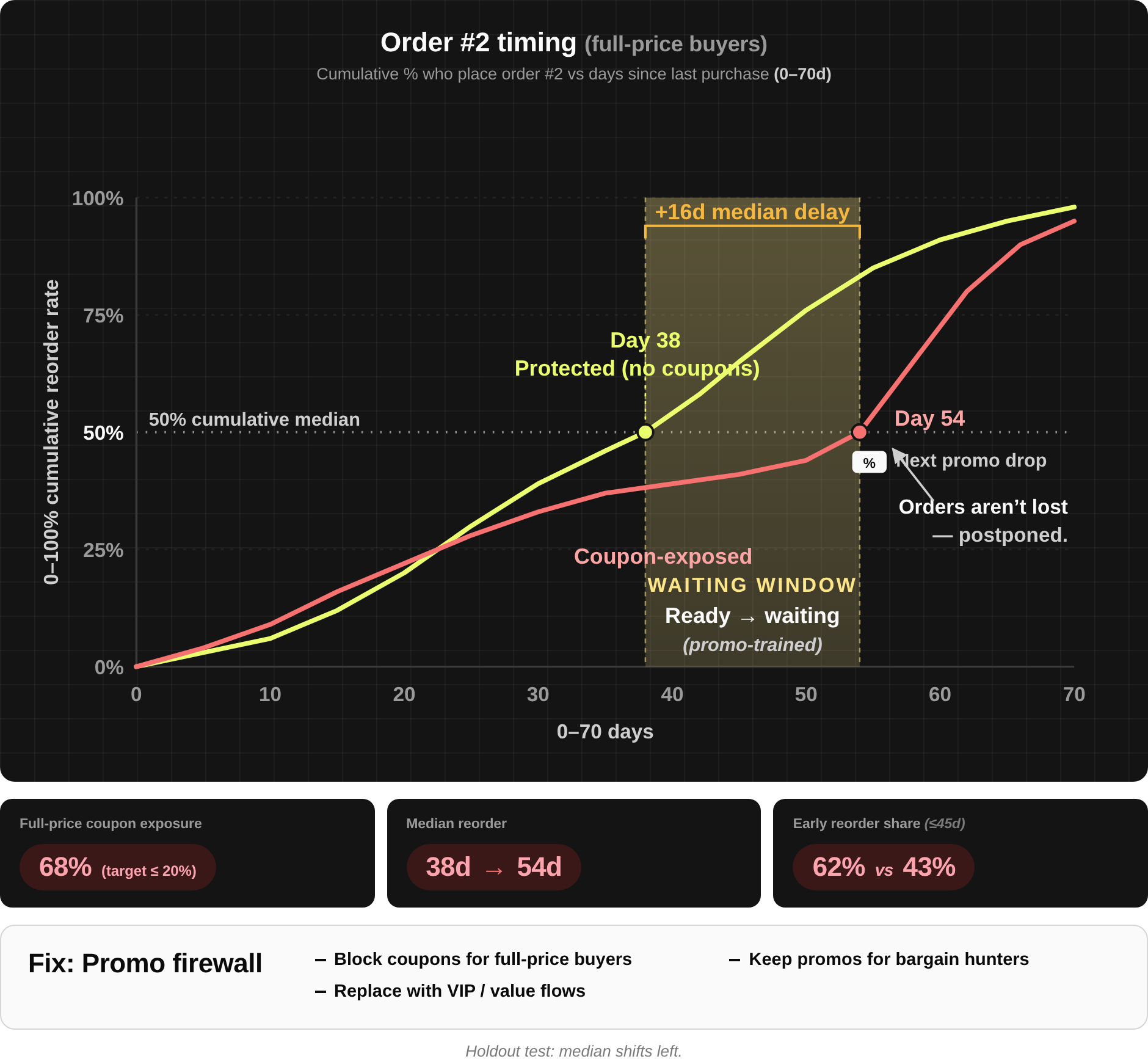
Couponing full-price buyers creates a hesitation window. Order #2 doesn’t disappear — it shifts right.
A full-price customer has already told you something useful: price isn't the barrier. They bought without an incentive, which means their buying rhythm works on its own. Send them a predictable coupon and you do more than give away margin. You teach them to wait for the next one.
Once a customer knows your sales are coming, the next purchase stops happening when they run low on the product. It happens when the discount lands. So you give up margin on an order that would have been full price, and over time you get fewer orders too, because a customer trained to wait buys less often than one who simply buys when they're ready.
How a good customer becomes promo-trained
A sitewide offer here. A winback coupon there. A "last chance" email that isn't really the last chance, because another one turns up 30 days later, with offers that get a little better the longer they hold out.
Your best buyers will learn quickly: Why buy today at full price when the brand has all but promised a discount is on the way? So they will wait. Not because they've cooled on the product, but because you've created an incentive structure in delaying the next purchase.
Multiply that across your best customers and two things happen at once. The orders that do come are discounted, so each one carries less margin. And some of the orders don't come at all, because a customer waiting for the perfect promo is a customer drifting out of the rhythm that made them valuable in the first place.
You gave up margin and delayed the next purchase.
5 principles that change how you should think about promotions
A discount changes timing, not just margin.
Most promo reporting measures the immediate order lift and discount cost. It rarely measures whether customers who received the offer started waiting longer between purchases. But if your median reorder window shifts right, the real cost includes slower cash recovery and a weaker organic buying cadence.
Full-price customers and bargain hunters are not the same audience.
A customer who bought at full price is giving you valuable information: price was not the primary barrier. Sending that person the same offer as a BFCM-only shopper ignores the signal and teaches a new behavior you did not need to create.
Promo-attributed revenue is not necessarily incremental revenue.
Some customers genuinely need an incentive. Others were already going to purchase and simply moved the order into the discount window. If sales spike during the promotion and soften immediately after, you may be looking at time compression, not growth.
Second-order delay is a cash-flow problem.
Moving order #2 from day 38 to day 54 does not merely change a CRM metric. It delays cumulative contribution margin, stretches payback, and increases the amount of capital required to support acquisition. The longer customers wait, the more expensive the cohort is to carry.
Promotions should be allocated like capital.
You would not give every channel the same budget regardless of economics. You should not give every customer the same discount regardless of behavior. Some segments deserve urgency and newness. Some need education. Some need replenishment cues. Only some genuinely need a price incentive.
The takeaway
Your best customers do not need to be persuaded that your products have value. They need a relevant reason to continue the relationship at the moment they are naturally ready.
When you coupon full-price buyers, you are not only sacrificing margin today. You are teaching them to delay tomorrow’s order. Protect their cadence, keep your pricing credible, and use promotions surgically for the customers whose behavior actually justifies them.
Ask me anything.
Smart questions from operators in my inbox — my honest answers on the promo trap.

The cleanest way is a holdout. Take a segment of full‑price buyers, suppress them from the promo, and compare against the exposed group over the full window — not just during the campaign. I’d look at cumulative CM1, days to next order, full‑price repeat rate, and whether the post‑promo period craters. If the exposed group buys during the promo but ends up with similar or worse total CM1 over 60–90 days, the promo didn’t create much — it mostly moved timing.
Start simple: customers with low or zero historical coupon usage, positive CM1 after returns, and at least one full‑price purchase. Then layer in repeat behavior — if they already come back without incentives, they should be protected more aggressively. I wouldn’t make it too academic at first. The goal is to identify people who don’t need price as the reason to buy — and stop teaching them that they should wait for one.
You’re right — a promo firewall has to be cross‑channel, not just email segmentation. If a sitewide banner is truly unavoidable, reduce the damage: limit frequency, narrow paid amplification, exclude protected segments from promo retargeting, and use different onsite modules where possible. The bigger point — “sitewide” should become the exception, not the default. If your best buyers constantly see universal discounts everywhere, your segmentation strategy is leaking.
I’d look for a pattern, not one order. The signs: purchase timing starts clustering around promo windows, full‑price repeat rate weakens, and the customer’s median gap between orders stretches despite continued engagement. The dangerous part is that promo training often looks like promo success in the dashboard. That’s why you need to measure timing and cumulative CM1 — not just campaign‑attributed revenue.
You can still protect the cleanest buyers, even in promo‑heavy categories. The difference is that “protection” may mean fewer blanket codes and more access‑based reasons to buy: early drops, curated edits, limited bundles, shipping upgrades, or loyalty recognition. Discounts can still exist — they should just be targeted to segments where they’re truly incremental. The mistake is letting category norms train your best customers to behave like bargain hunters.
 Listen on Spotify