Next-Offer Reality Check · Product Journey
Coupons train price sensitivity.
Journey data trains habit.
Use product journey data to guide the next purchase — with relevance, not blanket promos.
The better your next-offer logic, the less you need to discount.
Discounts can create the illusion of retention while quietly eroding contribution margin, training price sensitivity, and slowing payback. The second and third order are too important to hand over to blanket promos. If you want healthier LTV and more scalable growth, you need to make the next purchase feel relevant, not merely cheaper.
A simple example
Take an apparel brand with a strong first-purchase hero: a cashmere cardigan.
Most brands handle the next step the lazy way:
“Here’s 10% off your next order.”
“Complete your purchase with a discount.”
It works sometimes. But it also teaches the customer something dangerous:
Your next order requires a coupon.
Now compare that with a smarter approach.
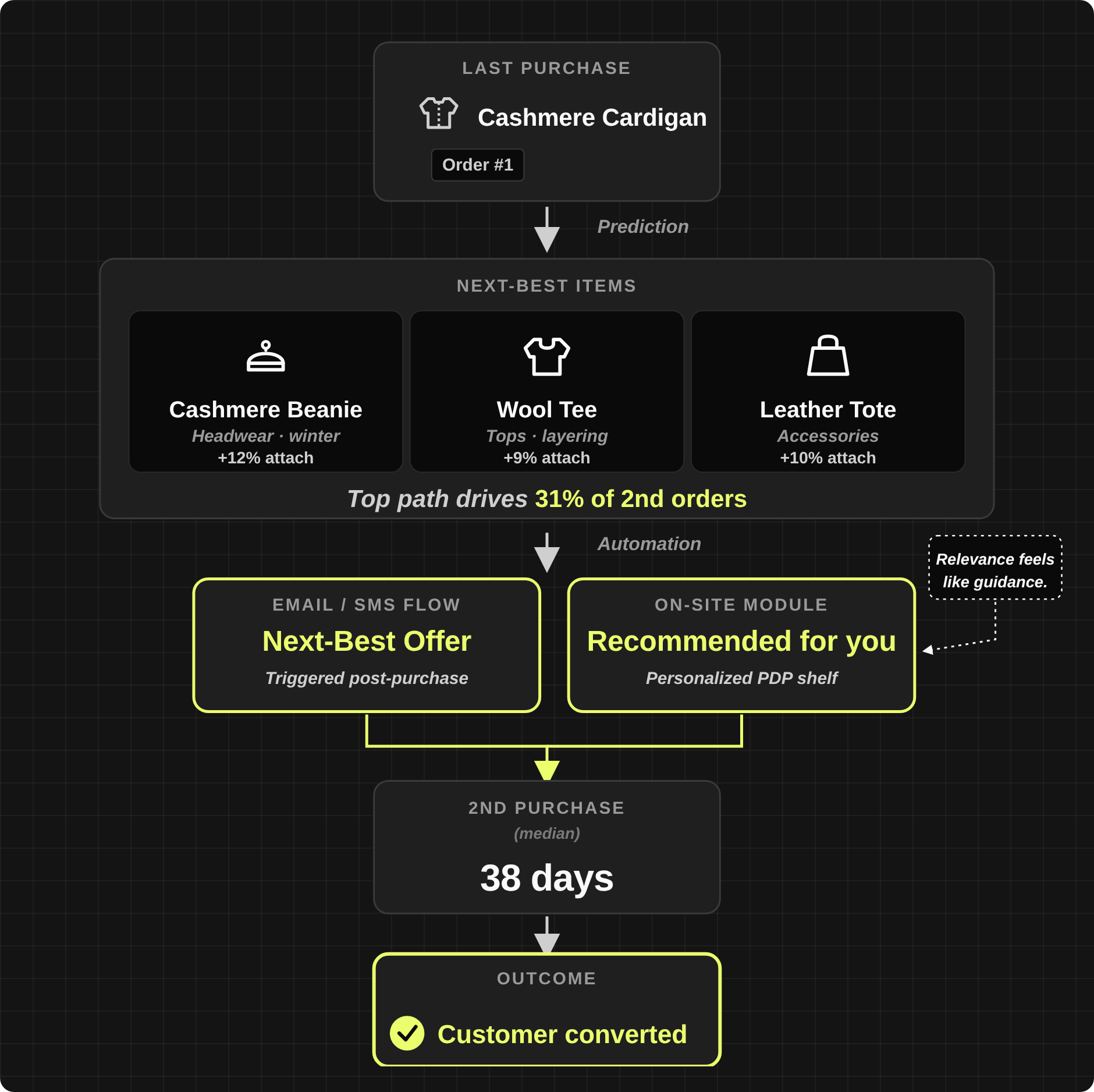
Instead of offering a broad discount, the brand looks at product journey data and sees what customers who bought the cardigan naturally tend to buy next:
Now the post-purchase email, SMS, and onsite recommendation are not saying, “Please buy again.”
They’re saying, “Here’s the next item that actually makes sense.”
That changes the psychology completely.
The customer is no longer evaluating:
“Do I want to spend again?”
“Should I wait for a better promo?”
“Can I save 10% if I hold out?”
Instead, the customer is evaluating:
“Yes, that fits what I just bought.”
“That completes the outfit.”
“That’s probably what I’d want next anyway.”
Relevance feels like guidance. Discounts feel like negotiation.
That difference matters far more than most teams realize.
What this changes in how you should think
The second order is not a promo problem. It’s a relevance problem.
A lot of brands assume weak repeat behavior means they need a stronger incentive. Usually, it means the brand is showing the wrong next product, at the wrong time, with the wrong framing. If the offer is relevant enough, you need less promotional force to get the order.
Blanket discounts teach a habit you do not want.
Every broad post-purchase coupon teaches the customer to associate return behavior with price reduction. Over time, that lowers full-price conversion, compresses CM1, and makes the business more dependent on margin giveaways just to maintain repeat volume. That is not retention. That is subsidy.
Product journeys are one of the cleanest sources of truth in ecommerce.
Customers are already showing you what makes sense next. The sequence lives in your order history: first purchase, second purchase, third purchase, category expansion, time to reorder. If you ignore that and keep showing generic “bestsellers” or margin-first products, you are forcing your own agenda onto the customer instead of following their natural path.
Not every SKU should be the next offer.
Some products are good for entry. Some are good for retention. Some are great for margin but terrible as order #2. The next-offer slot should be earned by products that increase repeat probability, not just by products you want to move. That is a portfolio decision, not just a CRM one.
The better your next-offer logic, the less you need discounts to create frequency.
That is the strategic unlock. If you can increase second- and third-order conversion through behavioral relevance instead of price cuts, you improve:
and ultimately what you can afford to spend on acquisition
|
✓
|
|
The Operator Playbook
|
| What to actually change |
| Five operator moves to turn the next offer into a real second-purchase engine. |
|
|
|
|
Map real product journeys from order #1 to order #2.
Don’t guess. Pull the actual next-purchase paths for your top first-order products. Look for:
| • |
The most common next item |
| • |
The strongest category progression |
| • |
The time gap between orders |
| • |
Which paths create stronger LTV90 / LTV180 |
You want to know what customers naturally do when they stick.
|
|
|
Stop using one generic post-purchase offer across the catalog.
The next item after a protein powder is not the same as the next item after a mascara, a dress, or a sofa cover. Build logic by:
| • |
First-purchase product |
| • |
First-purchase category |
| • |
Customer type |
| • |
Time since last order |
The more specific the path, the more the recommendation feels helpful.
|
|
|
Measure next-offer success on repeat quality, not just clicks.
A “winning” recommendation is not the one with the best CTR. It is the one that improves:
| • |
Second-order conversion |
| • |
Margin per customer |
| • |
Speed to next order |
| • |
Downstream LTV |
Don’t let email metrics choose your retention strategy. Use cohort outcomes.
|
|
|
Reserve discounts for friction, not for default.
If someone is overdue, at risk, or truly price-sensitive, a targeted incentive can make sense. But that should be the exception, not the baseline logic after every first purchase. The default should be:
| • |
Relevance |
| • |
Timing |
| • |
Product fit |
| • |
Low-friction paths to the next order |
|
|
|
Use the same next-offer logic across channels.
If email says one thing, SMS says another, and the PDP shelf shows random items, the system breaks. The strongest brands make the customer feel guided everywhere:
| • |
Post-purchase flow |
| • |
Onsite recommendation modules |
| • |
Retargeting creative |
| • |
Customer service guidance |
| • |
Merchandising placement |
The path should feel coherent.
|
|
|
BOOK YOUR AUDIT →
|
|
The real takeaway
Customers do not build buying habits because you offered 10% off often enough. They build habits because the next purchase keeps feeling obvious, relevant, and worth making. That is what product journey data gives you: a way to guide the next order without training the wrong behavior.
If you get this right, you do not just lift repeat rate. You create a healthier business: stronger full-price retention, better CM1, faster payback, and cleaner scaling. The better your next-offer logic, the less you need to discount your way into retention.
|
Reader questions
|
| Ask me anything. |
| Smart questions from operators in my inbox — my honest answers. |
|
|
|
|
|
Alex says · Founder RetentionX |
|
| I tie timing to the customer’s observed next-order window, not a calendar default. Start with delivery/usage reality: send the first nudge after value is likely realized, then place the “next offer” inside the historical peak window for that product path. If the median second purchase is ~38 days, you don’t blast on day 7 — you build toward that window. Keep it sparse: one helpful nudge, one decision nudge, then stop. |
|
|
|
How do you keep the “next-best” suggestions margin-safe and inventory-safe? |
|
|
|
|
Alex says · Founder RetentionX |
|
| Think of it as two layers: behavioral likelihood first, then business constraints. The journey data tells you what customers naturally do next; the rules layer ensures you only push items that are in-stock, margin-safe, and not return-prone. If the top suggestion fails constraints, you move to #2 / #3 without breaking the journey. The goal is relevance within guardrails, not a pure “most likely” list. |
|
|
|
What’s your approach to proving this is incremental vs just pull-forward? |
|
|
|
|
Alex says · Founder RetentionX |
|
| Judge it on a fixed window, not the first bump: 90 / 180-day CM1 per new customer and repeat depth (not just “time-to-order-2”). If you only pull demand forward, the curve flattens later and profit per customer doesn’t rise. If you can, run a small holdout (no next-offer) to estimate counterfactual. The win condition is more profit over the window with less discount depth — not just faster orders. |
|
|
|
How do you handle multi-item first orders or bundles? |
|
|
|
|
Alex says · Founder RetentionX |
|
| You anchor the journey on the “intent driver,” not the receipt. Identify the primary category or hero item in the first order (the one that predicts the next behavior) and build the next step off that, then use the other items as modifiers. For bundles, the next step is often a replenishment / upgrade / accessory path — not “another bundle.” Avoid generic add-ons and recommend what high-LTV customers actually buy next after that specific start state. |
|
|
|
Do you run this cross-channel with one unified rule, or does each channel get its own version? |
|
|
|
|
Alex says · Founder RetentionX |
|
| One unified brain, different executions. The logic (who gets what next and when) should be consistent across channels so you don’t spam or contradict yourself. Email/SMS is great for guidance, onsite is great for timing reinforcement, and ads are great for capturing intent when they’re browsing again. Coordinate frequency and suppression across channels so the customer experiences one coherent journey, not three separate campaigns. |
|
|


 Listen on Spotify